Sheshnag Lake Row: Minister’s Claim, BRO Work & Environmental Probe
By: Javid Amin | November 25, 2026
The Sheshnag Lake controversy has entered a new phase. The Jammu and Kashmir government says an inspection by a 12-member team found no environmental damage to the lake during Border Roads Organisation (BRO) work. The minister responsible for the environment says not a single grain of soil entered the water body.
But the government’s reassurance has not ended the dispute. Instead, it has sharpened a different question: if the lake is safe, why has the controversy over the nature of the work, its approval, its environmental safeguards and independent access to the site continued to grow?
At the centre of the latest developments are two competing narratives. Forest, Ecology and Environment Minister Altaf Ahmad Wani says departmental officials inspected the area and found Sheshnag Lake safe, with no tampering of the existing track. The opposition PDP, led by Mehbooba Mufti, alleges that the Omar Abdullah-led Cabinet cleared the road project through an extension of the memorandum of understanding with BRO’s Project Beacon in January this year.
The ruling National Conference rejects the description of the work as a newly sanctioned road, maintaining that the agreement concerns pending and critical Amarnath track works, including slope stabilisation and snow clearance.
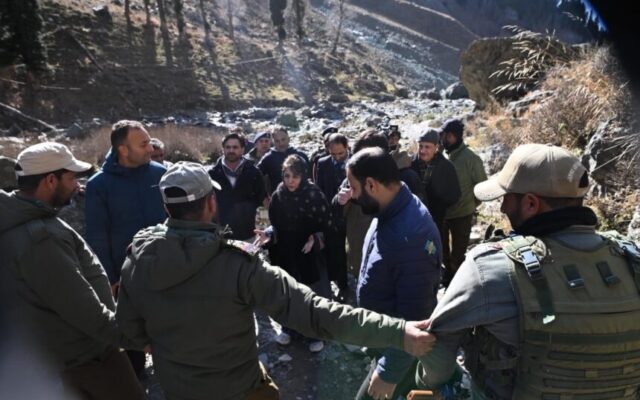
Meanwhile, Chief Minister Omar Abdullah has sought a ground report to establish whether any norms were violated, and the Forest Minister’s own planned visit reportedly did not proceed beyond a point because of security arrangements.
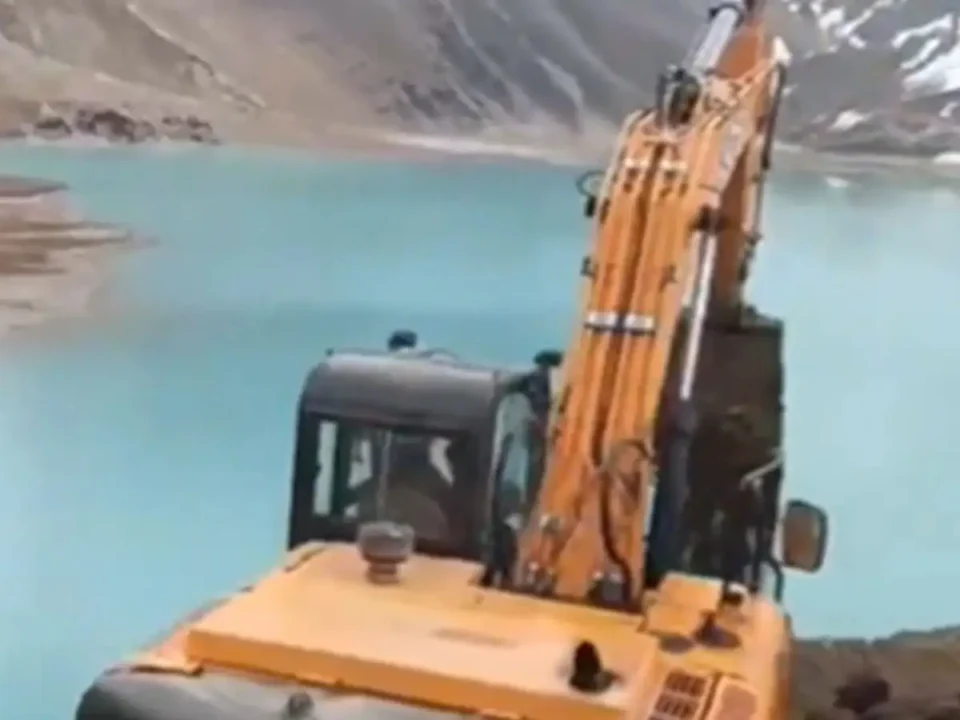
The dispute has moved beyond a viral video of an excavator. It now involves the credibility of official inspections, the difference between a road project and track maintenance, the environmental risks of mountain engineering and the public’s right to see evidence.
The 12-member inspection: What the government says it found
The strongest official response so far has come from Forest, Ecology and Environment Minister Altaf Ahmad Wani, also referred to as Altaf Kaloo, who said Chief Minister Omar Abdullah asked him to examine the controversy after the video went viral.
According to reports published on November 26, the minister said a 12-member team of officials inspected the site on Tuesday and found no evidence of damage to Sheshnag Lake. He said the inspection report indicated that soil had not entered the lake and that the existing track had not been tampered with.
The minister also offered a detail that is central to the dispute: he said the track was approximately 200 to 300 feet from the lake, arguing that the distance was not apparent in the circulating video because of the camera angle.
The government is therefore making three distinct claims:
-
The lake has not been contaminated by soil from the work.
-
The track’s existing alignment has not been altered.
-
The machinery was operating at a distance from the lake, reportedly 200 to 300 feet.
These statements are important, but the public has not yet been presented with the full inspection report, including its methodology, site maps, photographs, measurements and supporting observations.
A 12-member inspection may provide useful preliminary information. But the strength of the conclusion depends on what the team examined, how the distance was measured, whether it assessed slope and drainage risks, and whether it checked the entire work area or only the lake’s immediate shoreline.
The government has offered an assurance. The next step should be making the evidence behind that assurance publicly verifiable.
The 200- to 300-foot distance: Does it settle the environmental question?
The minister’s claim that the track is 200 to 300 feet from the lake is likely to become one of the most discussed details in the controversy.
Distance matters. The farther construction is from the lake, the lower some direct risks may be, particularly if excavation is not connected to a stream, drainage channel or unstable slope that leads into the water body.
But distance alone does not establish environmental safety.
A site located hundreds of feet away could still affect a lake if runoff carries sediment through a connected drainage channel. Conversely, excavation near a lake may have limited impact if it is conducted on stable ground, tightly controlled and supported by effective engineering measures.
A meaningful assessment should therefore examine:
-
The exact location and coordinates of the excavation.
-
The vertical and horizontal distance from the lake.
-
The slope gradient and geological composition.
-
Whether any natural drainage channels connect the worksite to the lake.
-
The volume and placement of excavated material.
-
Runoff and erosion-control measures.
-
The condition of the site before and after work.
The public needs to see a map showing the work footprint and lake boundary, not simply hear a distance quoted at a press conference.
The real political dispute: Was a road approved, or was an existing pilgrimage track being maintained?
Perhaps the most consequential disagreement is not about the excavator itself, but about the nature of the project and how it was approved.
Mehbooba Mufti has alleged that on January 23, 2026, the Omar Abdullah-led Cabinet cleared the road project near Sheshnag by extending the MoU with BRO’s Project Beacon. She has questioned why the government approved the work and demanded that the agreement and its clearance be explained.
The National Conference disputes her description of the decision as approval for a new road to Sheshnag.
NC spokespersons have argued that the arrangement relates to pending and critical work on the Shri Amarnath Ji Yatra tracks, including track maintenance, slope stabilisation and snow clearance. The party has also pointed to an earlier project timeline, claiming the proposal was brought by BRO in 2022, the MoU was signed in 2023 and approval was granted in 2024 by the relevant committee under the Lieutenant Governor’s administration.
This creates a crucial distinction that needs to be resolved through documentary evidence.
| PDP’s allegation | NC’s explanation |
|---|---|
| The Omar Abdullah Cabinet cleared a road to Sheshnag through an MoU extension on January 23, 2026. | The agreement concerns completion of pending Amarnath track works, not sanctioning a new road to the lake. |
| The government must explain the clearance and reconsider the project. | The project originated earlier, with a 2022 proposal, 2023 MoU and 2024 approval, according to the party. |
| Construction risks damage to the alpine ecosystem. | Existing pilgrimage track maintenance, slope stabilisation and snow clearance are necessary for safety. |
The discrepancy cannot be resolved through political speeches.
The original MoU, Cabinet decision or extension record, approval documents, work order and project map should be released. These would help establish whether the January 23 decision authorised a new road, renewed an existing arrangement, extended maintenance work or approved a particular set of activities.
Until those documents are examined, the public debate risks being trapped between two descriptions of the same project.
Omar Abdullah has ordered a report. What should it contain?
The Chief Minister has sought a report into the work, with the Forest Minister tasked to look into the concerns. The ruling National Conference has also said the Pollution Control Board, Environment and Wildlife departments were asked to seek detailed information and assess the environmental implications.
This is a significant development because it means the issue is no longer only being answered by the executing agency or political spokespersons. The administration has acknowledged the need for further examination.
But the value of the inquiry will depend on its scope.
A credible report should not simply conclude that the lake is “safe.” It should establish how that conclusion was reached.
What the inquiry should examine
Geological stability
Slope-cutting, loose glacial deposits, erosion potential, rockfall and landslide risks.
Water and drainage
Sediment pathways, runoff, nearby streams, drainage channels and potential water-quality impacts.
Excavated material
Quantity of soil and rock removed, disposal sites, debris containment and any material washed downslope.
Vegetation and habitat
Damage to alpine plants, ground cover, habitat disturbance and restoration needs.
Project permissions, applicable clearances, work boundaries and adherence to approved specifications.
The report should include photographs, geotagged observations, coordinates, maps, measurements, findings and recommendations. Where possible, it should compare the ground situation with the original approved plan.
If the inspection concludes that no environmental damage has occurred, the evidence should be published to support that conclusion. If it identifies a problem, the report should specify the corrective measures and whether work needs to be modified or stopped.
A transparent report could resolve much of the current uncertainty.
The inspection is not the same as an independent environmental audit
One important distinction has been largely lost in the political debate: the reported 12-member team was a government departmental inspection team. The minister’s statement establishes the government’s findings, but it does not automatically make the inspection an independent scientific audit.
An independent review would ideally involve experts who are not directly part of the project execution or the department defending the work, including specialists in:
-
Glacial geomorphology
-
Hydrology and watershed management
-
Mountain geology and slope stability
-
Alpine ecology
-
Environmental impact assessment
-
Disaster-risk analysis
This does not mean the departmental inspection is invalid. Government teams can conduct credible technical inspections. But when the controversy involves disputed claims, restricted access and public mistrust, a separate independent assessment would provide a stronger basis for confidence.
The difference is particularly important when the official conclusion is categorical, such as a claim that no soil entered the lake or that the ecosystem remains completely safe. Those are claims that should be supported by evidence proportionate to their certainty.
Why restricted access is fuelling suspicion
The controversy has also been aggravated by reported restrictions on visits to the site.
Mehbooba Mufti and accompanying PDP leaders were stopped at Chandanwari while attempting to visit Sheshnag. Separately, Forest Minister Altaf Ahmad Wani said he himself could not proceed to the lake for an on-site visit because of security concerns and inadequate security arrangements, despite being directed to investigate by the Chief Minister.
These are separate circumstances, but together they have created an uncomfortable perception: political representatives and even the minister responsible for the environment have not all been able to personally reach the location in question.
The restrictions may have legitimate security reasons in a difficult and sensitive mountain area. The available reporting does not establish that access was restricted specifically to conceal environmental damage.
However, where access is restricted, the administration has a greater responsibility to ensure independent verification through an authorised, transparent process.
A practical solution would be to arrange a supervised site visit for a credible multidisciplinary team, with access to the relevant work area, lake margin, drainage points and spoil-disposal locations. The team should be able to document observations independently and publish its findings.
If the area is safe and the work is compliant, transparent access and documentation should help demonstrate that.
Political blame is growing, but the ecological question risks getting lost
The National Conference has rejected Mehbooba Mufti’s allegation that its Cabinet approved a new road to Sheshnag, arguing that the agreement is about completing pending and critical pilgrimage-track work. The PDP insists the January 2026 Cabinet action needs to be explained. The BJP has accused critics of politicising development and the pilgrimage.
People’s Conference president Sajad Lone has criticised the NC-PDP blame game, warning that political exchanges could overshadow the ecological issue and allow those responsible to avoid accountability. His argument is that environmentalists and scientific assessments should lead the debate, rather than party calculations.
CPI(M) leader and MLA Mohammad Yousuf Tarigami has also expressed concern over possible ecological imbalance, called for the work to be suspended pending expert clearances and advocated an independent committee to review the project.
These positions point to a common need, even though the political interpretations differ: the controversy requires a technical resolution.
When environmental issues become partisan contests, facts often get buried beneath accusations. One side may overstate the damage before it is verified; another may dismiss the risks because the criticism comes from political opponents. Neither approach helps protect the lake.
Environmental oversight should be able to function independently of who raises the concern.
What Sheshnag’s high-risk glacial lake status means
That classification is important, but it needs to be understood correctly. It does not mean a glacial lake outburst flood is imminent. Nor does it establish that the ongoing construction has altered the lake’s stability.
It does mean that the lake and surrounding landscape deserve careful monitoring and risk assessment.
Mountain lakes are connected to their catchments. Water flows from surrounding slopes through snowmelt, rainfall, streams and drainage channels. Excavation, slope cutting, material dumping or poorly designed drainage may alter some of these processes.
The environmental assessment should therefore go beyond checking whether visible soil has entered the water.
A lake could remain visually clear while construction creates erosion risks elsewhere. Equally, machinery operating in the vicinity does not automatically mean the lake has been damaged.
The relevant scientific questions include whether the work has altered natural drainage, exposed unstable material, affected the lake’s catchment or increased the potential for sediment movement during future rain or snowmelt.
That is why an assessment of the wider landscape is essential.
The petition’s growing numbers reflect public concern, not a scientific verdict
The online campaign titled “Stop Construction Around Kashmir’s Alpine Lakes,” initiated by Zarqua Banday, has continued to gather signatures.
News reports have cited different numbers as the petition gained traction. The New Indian Express reported more than 4,500 signatures, while Deccan Chronicle cited 8,663 at the time of its report.
The figures reflect different reporting snapshots and should not be treated as simultaneous counts. The petition calls for engagement with local environmental and community groups and a sustainable approach to protecting alpine lakes.
The campaign’s growth is evidence of increasing public attention. It is not, by itself, proof that the project has violated environmental law or caused ecological damage.
But it sends a message to the administration that people want greater transparency around development in fragile areas.
The government should treat that message seriously.
What transparency could actually look like
If the government wants to end the Sheshnag controversy rather than prolong it, it could release a small but meaningful package of documents and evidence:
A public disclosure checklist
This would be far more effective than continuing to trade statements.
It would also establish a useful precedent for future infrastructure work in ecologically sensitive areas of Jammu and Kashmir, where public scrutiny is likely to grow as climate risks and development pressures increase.
The real environmental risk is not just what happened yesterday, but what happens next
Mountain ecosystems are particularly vulnerable to cumulative disturbance. One small excavation may have limited consequences. But repeated widening, cutting, debris dumping, traffic, drainage changes and infrastructure expansion can gradually alter the landscape.
This is why environmentalists are concerned about the long-term footprint of construction near alpine lakes, not only whether the water appears clean immediately after work.
In Kashmir, where glaciers, water bodies, forests and mountain slopes are increasingly exposed to climate pressures, preventive environmental assessment is more important than waiting for damage to become visible.
A responsible project should have clear boundaries, proper engineering, adequate drainage, controlled excavation, safe disposal of material and restoration measures. It should also be monitored after construction, particularly during snowmelt and periods of heavy precipitation.
If the government says these safeguards are in place at Sheshnag, publishing the evidence would help establish confidence.
Omar Abdullah’s government has a chance to end the uncertainty
The Sheshnag controversy now presents Chief Minister Omar Abdullah with an opportunity to move the discussion away from political blame and towards a transparent, evidence-based resolution.
The government has already sought a report, and the Forest Minister has publicly stated that the departmental team found the lake safe. Those are important developments. But they should be followed by the release of the report, project documents and an independent technical review capable of addressing the remaining concerns.
The administration should also clarify the disputed project timeline: what was proposed in 2022, what was agreed in 2023, what approval was granted in 2024, and what the January 2026 Cabinet decision actually authorised. The distinction between track maintenance, slope stabilisation and a new road is central to the controversy, and it should be settled through the original documents.
If the work is within the approved scope and environmental safeguards have been followed, transparency can help clear the air. If violations or risks are identified, corrective action should follow without delay.
The government should not view independent scrutiny as a challenge to its authority. In an environmentally sensitive region, it is part of responsible governance.
Sheshnag deserves facts, not a political tug-of-war
The Sheshnag Lake row has exposed a familiar problem in Kashmir: environmental concerns often become political controversies before the public receives the documents and evidence needed to understand what is happening.
The government says the lake is safe. The opposition disputes the project’s approval and demands answers. Environmental groups want an independent investigation. Political parties are accusing one another of exploiting the issue. Citizens are left trying to make sense of competing claims.
The 12-member inspection may have found no soil entering the lake. That is reassuring if supported by credible evidence. But it does not automatically answer every question about slope stability, drainage, excavation, long-term impacts or the project’s authorisation.
The way forward is not another round of accusations. It is a transparent inspection, a publicly available report, an independent scientific assessment and a clear explanation of the project.
Sheshnag Lake should not become a casualty of either unchecked development or political point-scoring. It deserves a decision-making process that is open, scientific and accountable, before the fragile Himalayan landscape is asked to absorb more intervention.