Mirwaiz Umar Farooq Slams Silence of J&K Leaders Over Eid Prayer Curbs, Warns Against ‘Normalising the Abnormal’
By: Javid Amin | 30 May 2026
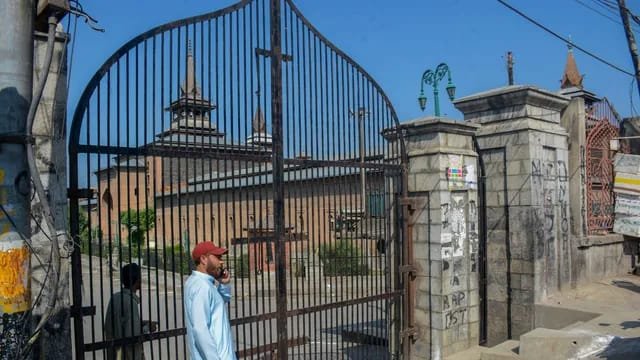
A fresh political and religious debate has emerged in Jammu and Kashmir after Mirwaiz Umar Farooq strongly criticised the silence of elected representatives over continued restrictions on Eid congregational prayers at Srinagar’s historic Eidgah Srinagar and Jamia Masjid Srinagar.
Speaking after authorities once again disallowed large Eid gatherings at the two iconic religious venues, the Mirwaiz questioned why political leaders and elected representatives have remained largely silent despite repeated curbs affecting one of the most significant religious occasions for Muslims.
His remarks have reignited discussions around religious freedoms, democratic accountability, cultural identity and the evolving relationship between governance and public religious life in Kashmir.
Mirwaiz: The Greatest Danger Is When the Abnormal Becomes Normal
At the heart of the Mirwaiz’s criticism was a warning against what he described as the gradual normalization of extraordinary restrictions.
According to him, the continued denial of congregational Eid prayers at traditional venues is no longer being treated as an exceptional measure but is increasingly being accepted as routine. He cautioned that societies face a serious challenge when repeated restrictions become so common that people stop questioning them.
The concern, he suggested, extends beyond a single Eid or a single year. It touches upon how future generations may perceive religious rights and public worship if restrictions continue uninterrupted over long periods.
For many Kashmiris, Eid prayers at Eidgah and Jamia Masjid carry not only religious significance but also deep cultural and historical meaning. The venues have traditionally served as gathering spaces where thousands of worshippers come together on major Islamic occasions.
Sixth Consecutive Year of Restrictions
This year’s restrictions marked the sixth consecutive year in which congregational Eid prayers were reportedly not permitted at Srinagar’s major religious venues.
The continued absence of large Eid gatherings at Eidgah and Jamia Masjid has become a recurring feature of major Islamic festivals in Kashmir over recent years.
The issue has often generated public debate, particularly because the restrictions coincide with occasions that hold immense emotional and spiritual importance for the Muslim majority in the Valley.
Community members have frequently expressed disappointment over the inability to offer Eid prayers at locations that have historically served as focal points of collective worship and social interaction.
Many worshippers view these spaces as symbols of Kashmir’s religious heritage and communal identity, making their closure during important festivals especially sensitive.
Sharp Criticism of Elected Representatives
The Mirwaiz reserved some of his strongest remarks for elected political leaders in Jammu and Kashmir.
He argued that representatives who have been elected to public office carry a responsibility to speak on issues affecting the rights and concerns of their constituents. Remaining silent, he suggested, weakens the very purpose of democratic representation.
According to his argument, leadership is tested not during periods of stability and comfort, but during moments when rights and freedoms come under scrutiny.
The criticism reflects a broader perception among sections of society that mainstream political parties have become increasingly cautious in confronting administrative decisions related to religious and civic matters.
The remarks may also place renewed pressure on political parties, including the Jammu and Kashmir National Conference and the Jammu and Kashmir People’s Democratic Party, which have faced questions from some constituents regarding their response to recurring restrictions on major religious events.
More Than a Religious Issue
While the immediate controversy revolves around Eid prayers, the debate extends far beyond access to religious venues.
For supporters of the Mirwaiz’s position, the issue concerns broader questions of constitutional freedoms, cultural preservation and public participation in religious life.
They argue that repeated restrictions on collective worship risk creating a sense of alienation among ordinary citizens and contribute to the perception that traditional religious practices are being increasingly regulated.
Others maintain that administrative decisions are often taken in the interest of security and public order, particularly in a region that has historically experienced political and security challenges.
The differing perspectives highlight the complex balance authorities seek between governance concerns and the protection of religious freedoms.
Cultural Identity and Collective Memory
A significant element of the Mirwaiz’s remarks focused on cultural identity.
He warned that repeated interruptions to long-standing religious traditions raise concerns about whether Kashmir’s distinct religious and cultural character is being adequately respected.
Eidgah and Jamia Masjid are not merely prayer venues; they are deeply embedded in Kashmir’s social memory. Generations of families have associated these locations with Eid celebrations, community gatherings and important religious milestones.
When access to such spaces remains restricted over many years, concerns naturally emerge about the preservation of traditions that connect communities to their historical and cultural roots.
For many residents, the debate is therefore not only about worship but also about safeguarding collective heritage.
Growing Questions Around Democratic Accountability
The controversy has also revived discussions about democratic accountability in Jammu and Kashmir.
Political analysts note that public institutions are often judged by how effectively they respond to concerns surrounding civil liberties, religious rights and community sentiment.
The Mirwaiz’s intervention seeks to frame the issue as a test of representative politics: whether elected leaders are willing to publicly advocate for issues that resonate with large sections of the population.
His remarks are likely to fuel further debate in the coming weeks about the role of political parties, civil society groups and religious institutions in shaping public discourse in the region.
Community Sentiment: Disappointment and Alienation
Among many worshippers, the continued restrictions have generated feelings of disappointment and emotional disconnect.
For countless families, Eid prayers at Eidgah and Jamia Masjid have historically been central to the festival experience. The inability to gather collectively at these iconic locations has altered the character of Eid celebrations for many residents.
Several community members argue that while prayers can be performed elsewhere, the symbolic and emotional significance of these historic congregations cannot easily be replaced.
As a result, some view the restrictions as affecting not only religious practice but also the communal spirit traditionally associated with Eid.
The Larger Debate
The remarks by Mirwaiz Umar Farooq underscore a larger conversation unfolding in Kashmir about faith, governance, civil liberties and cultural identity.
His central argument is that the issue is no longer limited to a single festival or a single administrative decision. Rather, it concerns whether repeated restrictions on religious gatherings are gradually becoming accepted as a permanent reality.
For supporters, the warning is about protecting religious rights and cultural traditions. For authorities, the emphasis often remains on administrative and security considerations.
The continuing debate reflects one of the most sensitive questions facing Kashmir today: how to balance governance imperatives with the preservation of religious freedoms, democratic accountability and cultural heritage.
As discussions continue, the controversy surrounding Eid prayers at Eidgah and Jamia Masjid remains a powerful symbol of the broader tensions shaping public life in Jammu and Kashmir.


