Ruhullah Mehdi vs NC: Why Statehood Has Triggered a Fresh Constitutional Debate in J&K
By: Javid Amin | 04 October 2026
Srinagar: The widening political differences between National Conference (NC) MP Aga Syed Ruhullah Mehdi and the party leadership have taken another turn, with the Srinagar parliamentarian accusing the Jammu and Kashmir government led by his own party of diluting the mandate it received in the 2024 Assembly elections.
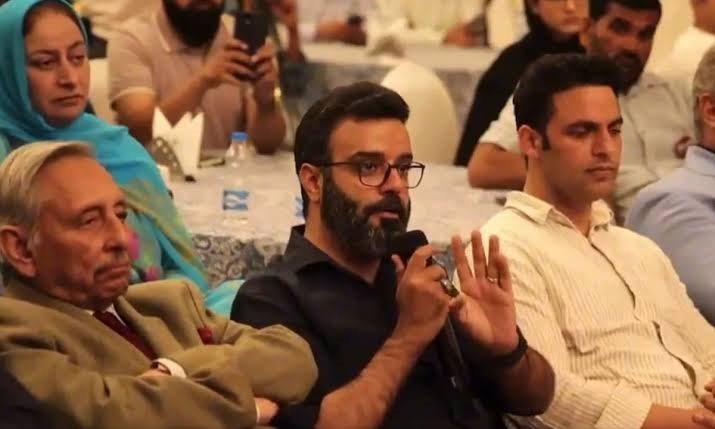
Speaking at the fifth Halla Bolle Conclave in Srinagar on October 4, Mehdi alleged that the NC government had reduced the broader political struggle over Jammu and Kashmir’s constitutional and political rights to a demand for restoration of statehood.
He described that shift as a betrayal of the electoral mandate and argued that the party had not even begun what he considers the more fundamental fight for restoration of the constitutional position that existed before the changes of August 5, 2019.
The remarks come days after the J&K Assembly passed a resolution seeking the immediate and urgent restoration of full statehood, while retaining references to earlier Assembly resolutions of 2000 and 2024. The resolution itself has therefore become a new point of debate inside the NC, with Mehdi arguing that the formulation represents a narrowing rather than an expansion of the party’s original political commitments.
Ruhullah’s Central Charge: “The Goalposts Have Been Shifted”
At the heart of Mehdi’s criticism is a question of what exactly the NC’s 2024 electoral mandate authorised the party to pursue.
According to Mehdi, voters did not elect the NC merely to seek the return of statehood. He argues that the mandate was broader and included a political commitment to fight for the restoration of constitutional and political guarantees that were altered or removed after August 5, 2019.
In his latest remarks, he said the party had brought the people’s struggle “down to statehood” and alleged that the NC had not started the fight for restoration of the constitutional rights that, in his formulation, were taken away in 2019.
Mehdi’s argument is therefore not simply about whether statehood should be restored. It is about whether statehood alone is an adequate political objective for a party that went into the 2024 elections with a broader constitutional agenda.
That distinction is now becoming increasingly important within the NC’s internal political debate.
What Did the NC Promise in 2024?
The NC’s 2024 Assembly election manifesto provides an important reference point for understanding Mehdi’s criticism.
The manifesto explicitly included restoration of Article 370 and Article 35A, restoration of Jammu and Kashmir’s statehood, and implementation of the Assembly’s 2000 autonomy resolution among its political guarantees. The party also promised to seek changes to the Jammu and Kashmir Reorganisation Act, 2019.
The manifesto therefore did not present statehood as the sole constitutional objective.
Its first major guarantee envisaged restoring what the party described as Jammu and Kashmir’s political and legal status prior to August 5, 2019, while also promising to work towards restoration of Article 370 and 35A and statehood.
That historical document is central to Mehdi’s present argument.
His contention is that the party sought votes on a wider political programme but is now pursuing a narrower demand after coming to power.
The NC leadership, however, has continued to describe restoration of statehood as a major political objective and has formally taken that demand to the Assembly and the Centre.
The September Statehood Resolution
The immediate backdrop to Mehdi’s latest criticism is the resolution passed by the Jammu and Kashmir Assembly on September 28.
Moved by Chief Minister Omar Abdullah, the resolution called upon the Government of India for the “immediate and urgent restoration of full statehood” to Jammu and Kashmir.
Importantly, the final text did not stand entirely on its own. It began by referring to resolutions passed by the Assembly on June 26, 2000, and November 6, 2024.
That wording became a major source of contention inside the House.
BJP legislators objected to the references to the earlier resolutions, particularly because of their association with autonomy and the constitutional position that existed before August 2019. The BJP has said it supports restoration of statehood but does not support using the demand as a vehicle for restoring the pre-2019 constitutional arrangement.
For Mehdi, however, the problem lies in the opposite direction.
He argues that even the references to earlier resolutions represent a diluted version of what the NC had originally promised.
From Autonomy to Article 370 — and Now Statehood?
The disagreement reflects a longer-running argument over how the NC’s political position has evolved since the 2024 election campaign.
During the campaign, the party explicitly spoke about Article 370, Article 35A, statehood and the implementation of the 2000 autonomy resolution.
Since taking office, however, the restoration of statehood has emerged as the most immediate constitutional demand being pursued by the elected government.
The September Assembly resolution demonstrates that shift in practical political emphasis, although the final text continued to refer to the 2000 and 2024 resolutions.
Mehdi argues that this evolution amounts to moving the political goalposts.
In his latest remarks, he said the earlier resolution had effectively been diluted and that the subsequent formulation reduced the demand to “only” statehood. He described that as a compromise with the broader mandate.
The argument is significant because it exposes two different interpretations of political sequencing.
One approach treats statehood restoration as the immediate achievable objective, after which wider constitutional questions can continue to be pursued politically or legally.
Mehdi’s position is different: he argues that reducing the agenda to statehood risks abandoning the larger constitutional commitments on which the NC sought the electorate’s support.
Why the 2000 Resolution Matters
The reference to the 2000 resolution is not incidental.
In June 2000, the Farooq Abdullah-led NC government passed an Assembly resolution seeking restoration of a substantially greater degree of autonomy for Jammu and Kashmir, including a return towards the constitutional position that existed before 1953.
The Union government headed by Prime Minister Atal Bihari Vajpayee subsequently rejected that resolution.
The resolution remained an important component of the NC’s political vocabulary for years.
The party’s 2024 manifesto again promised implementation of the 2000 autonomy resolution, alongside restoration of Article 370 and statehood.
That history explains why Mehdi sees the latest statehood resolution through a much wider lens.
For him, the question is not simply whether J&K should return to statehood after its conversion into a Union Territory in 2019. It is whether the NC remains committed to the larger autonomy and constitutional agenda that has historically defined the party’s politics.
The 2024 Resolution Added Another Layer
The Assembly’s November 2024 resolution is equally important to the present dispute.
The current Assembly’s September resolution specifically referred to that earlier resolution, which had dealt with restoration of the special constitutional status and guarantees associated with Jammu and Kashmir.
Thus, the September 2026 resolution effectively placed the statehood demand in continuity with the Assembly’s earlier political resolutions rather than treating it as an entirely new issue.
But Mehdi has questioned whether references to earlier resolutions are enough.
His argument is essentially that a reference to an earlier political demand is not the same thing as actively pursuing that demand.
That distinction lies at the centre of his criticism of the NC government.
“Mandate” Is Now the Key Word in the NC-Ruhullah Dispute
Mehdi’s repeated use of the word “mandate” is politically significant.
The NC won 42 of the 90 Assembly seats in the 2024 election and formed the government. Its manifesto had presented a multi-part political programme covering constitutional issues, statehood, political prisoners, jobs, land and employment protections and other matters.
Mehdi’s argument is that the electoral mandate should therefore be assessed against the entire programme rather than against one element of it.
His criticism is not that statehood is irrelevant. Rather, he argues that making statehood the central or principal constitutional demand amounts to narrowing what the electorate authorised the party to pursue.
That interpretation is his political assessment; whether voters understood the mandate in precisely that way cannot be established simply from the election result.
A Growing Rift Inside the Ruling Party
The latest comments also need to be viewed against the increasingly open disagreement between Mehdi and the NC leadership.
His differences with the party have been building for months, particularly around Article 370, constitutional guarantees, the government’s political strategy and the pace and direction of its pursuit of electoral commitments.
In August, Mehdi announced that he intended to resign from both the National Conference and the Lok Sabha on November 3, 2026. He subsequently described his departure from the party as a settled decision.
That means the latest criticism is coming from an NC parliamentarian who has already announced his intention to leave the organisation.
The timing matters.
Mehdi is no longer merely challenging an internal party position while seeking to remain within the organisation. His public statements increasingly suggest that he is defining the political differences that will shape his position after his planned departure.
His Criticism Goes Beyond the Assembly Resolution
The statehood dispute is only one part of Mehdi’s wider criticism.
In recent weeks, he has questioned the functioning of the J&K Assembly itself, describing it as a “wrestling ring” and arguing that elected representatives should be concentrating on issues such as healthcare, education, employment, water supply and other everyday concerns.
He has also criticised the continued institutional role of the Lieutenant Governor in the Union Territory framework and questioned what he regards as the limited authority available to the elected government.
In September, he described the Lieutenant Governor’s office as an “undemocratically imposed institution” and said he would rather pursue the reservation issue through elected political channels than approach the LG.
These remarks show that his disagreement with the NC leadership extends beyond a single resolution.
It concerns what he sees as the broader limits of governance and politics under the present Union Territory arrangement.
Omar Abdullah’s Position Has Been More Focused on Statehood
The NC government’s position has increasingly centred on restoration of statehood.
Chief Minister Omar Abdullah has argued that the demand for statehood should not be indefinitely postponed and has questioned the meaning of the Supreme Court’s direction that statehood be restored “at the earliest”.
When the Assembly debated the September resolution, Omar also argued that statehood should not be made contingent on the security situation or the continuation of militancy.
The Assembly ultimately passed the resolution after BJP legislators walked out amid protests over its references to the earlier political resolutions.
This creates an important distinction between Omar’s and Mehdi’s positions.
Omar’s government is pursuing restoration of statehood as the immediate institutional objective.
Mehdi is arguing that the constitutional agenda cannot be reduced to statehood.
Both positions arise within the broader post-2019 political debate, but they prioritise different stages and objectives.
BJP’s Position Adds Another Dimension
The dispute is not limited to the NC.
The BJP has said it supports restoration of statehood but opposes any attempt to use the statehood resolution to reopen the constitutional changes made in 2019.
During the September Assembly debate, BJP legislators objected specifically to references that they interpreted as connecting statehood with the pre-August 5, 2019 constitutional arrangement. The party subsequently walked out of the House before the resolution was adopted.
That places the three positions in sharper relief:
- The NC government: immediate restoration of full statehood, while retaining references to earlier Assembly resolutions.
- Ruhullah Mehdi: statehood alone is insufficient and, in his view, represents a dilution of the broader constitutional mandate.
- The BJP: supports statehood but opposes linking it to restoration of the pre-2019 constitutional framework.
The political disagreement is therefore no longer simply over whether J&K should regain statehood. It increasingly concerns what statehood means within the larger constitutional question.
Is Statehood the End Goal or the First Step?
This is likely to remain the central question in the debate.
For the NC government, restoring statehood would reverse one of the most consequential administrative changes made after 2019 and return greater institutional authority to an elected state government.
For Mehdi, however, statehood without restoration of the constitutional guarantees sought by the NC’s 2024 manifesto would represent only part of the promised agenda.
That is why he has described the present trajectory as a “dilution” of the mandate.
The distinction also matters legally and constitutionally. Restoration of statehood and restoration of Article 370 are separate questions. Returning J&K to statehood would not automatically recreate the constitutional arrangement that existed before August 2019.
Consequently, a future restoration of statehood could take place without necessarily restoring the former special-status framework.
The Political Cost of Repeated Resolutions
Mehdi has also questioned the NC’s use of successive Assembly resolutions.
He has argued that if the party had a clear objective when it went before voters, it should explain why subsequent resolutions appear to modify or narrow earlier formulations.
His criticism reflects a broader political question: what practical outcome is expected from Assembly resolutions when the power to alter J&K’s constitutional and territorial status ultimately lies beyond the Assembly itself?
The September resolution itself calls for the document to be forwarded to the Government of India. It therefore represents a formal political demand rather than an instrument that independently restores statehood.
This distinction is crucial to understanding why Mehdi is demanding clarity over what comes next.
What Happens After November 3?
Mehdi’s announced November 3 exit adds another layer of uncertainty to the political debate.
He has said he will resign from the NC and his Lok Sabha membership on that date and has indicated that he will decide his future political course after consulting people in Jammu and Kashmir.
His departure would transform the present disagreement from an internal NC dispute into a potentially independent political project, although Mehdi has not publicly finalised such a project.
For now, his principal argument is clear: he believes the NC’s 2024 mandate covered a wider constitutional and political agenda than the restoration of statehood alone.
A New Fault Line in J&K Politics
The debate emerging around Mehdi’s criticism is ultimately about more than one politician’s disagreement with his party.
It reflects a larger question confronting Jammu and Kashmir’s elected political leadership after the return of an Assembly: what should be the central political objective of the post-2019 government?
Should the immediate priority be restoration of statehood and greater institutional authority?
Should statehood be pursued alongside a longer-term campaign for constitutional changes?
Or should the political agenda remain anchored to the commitments made by parties before the 2024 election?
There is no single answer within J&K’s current political landscape.
The September Assembly resolution showed that statehood has become a major institutional demand. Ruhullah Mehdi’s latest intervention demonstrates that even within the National Conference’s broader political camp, there is disagreement over whether that demand represents the beginning of a larger constitutional campaign—or a narrowing of it.
For the NC leadership, the challenge is now not only to seek statehood from New Delhi but also to explain how that demand fits into the wider political commitments on which it sought the electorate’s support in 2024.
For Mehdi, the coming weeks will likely be about making the case that those commitments remain unfinished.
And with his announced departure from the NC approaching on November 3, the disagreement over statehood, autonomy and constitutional rights is increasingly becoming a defining political fault line within the regional politics of Jammu and Kashmir.