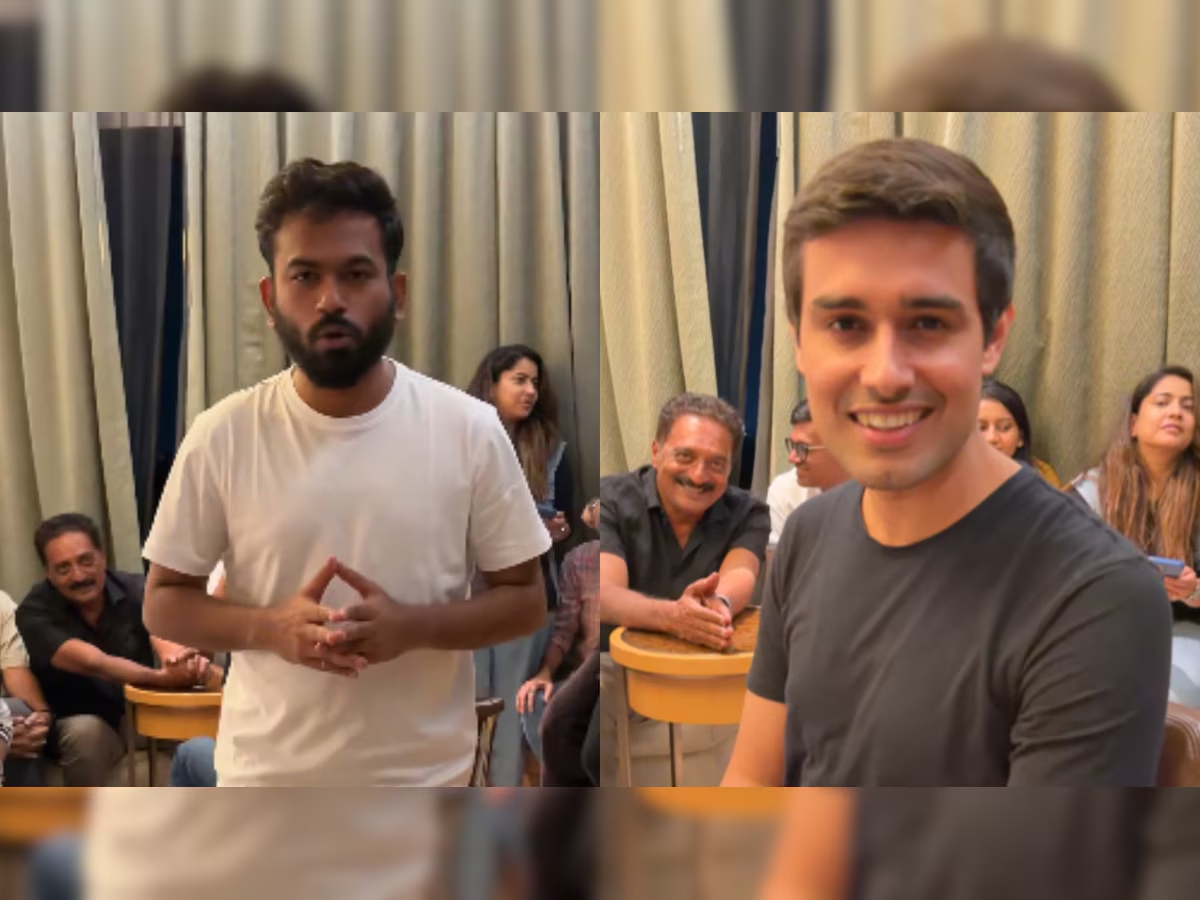
The YouTuber and political commentator was reportedly taken into custody from his Sector 56 residence before the Cockroach Janta Party’s planned Jantar Mantar demonstration. The reported detention comes amid extensive security restrictions and a wider dispute over the handling of protests against the Election Commission.
Javid Amin | Gurugram/New Delhi, October 10, 2026
YouTuber and political commentator Dhruv Rathee was detained by Delhi Police from his residence in Gurugram’s Sector 56 on Saturday morning, ahead of the proposed Cockroach Janta Party (CJP) protest at Jantar Mantar in New Delhi, according to multiple media reports.
The reported detention comes as authorities enforce extensive security arrangements across Delhi and adjoining areas to prevent an unauthorised demonstration demanding the resignation of Chief Election Commissioner Gyanesh Kumar over allegations concerning the revision of electoral rolls.
Rathee had publicly indicated his intention to join the protest. His reported detention has drawn attention to the wider police operation, which has included preventive detentions, barricading, transport restrictions and a temporary suspension of mobile internet services in parts of central Delhi.
The development has also prompted criticism from CJP supporters, who have demanded Rathee’s release and alleged that authorities are attempting to prevent people from reaching the demonstration.
While reports confirm that Rathee was detained, the specific legal grounds for his detention and the precise circumstances of his custody should be distinguished from the allegations made by the protest organisers.
Dhruv Rathee detained from his Gurugram residence
According to reports published on October 10, police teams arrived at Rathee’s residence in Sector 56, Gurugram, before the planned demonstration in Delhi.
Some reports, citing sources, said around 50 police personnel had gathered outside the residence before Rathee was taken into custody. The reported police presence preceded the protest scheduled at Jantar Mantar, where CJP and its supporters planned to raise demands concerning the Election Commission and electoral-roll revisions.
Rathee is one of India’s prominent online political commentators, known for videos examining public policy, government decisions and political developments. His planned participation in the CJP protest placed him among the public figures expected to join the demonstration.
The Hindustan Times report identified his residence as being in Kendriya Vihar society in Sector 56. Moneycontrol also reported his detention, citing News18.
The available reporting does not, by itself, establish the full legal basis for the action. Any assessment of its legality would require the relevant police order, grounds of detention or other official documentation.
From Bengaluru to Delhi: Rathee’s planned participation
Rathee had reportedly travelled to India from Germany earlier in the week and participated in a CJP-linked protest in Bengaluru on October 8.
The Bengaluru gathering was part of the campaign against the Special Intensive Revision (SIR) of electoral rolls and the leadership of Chief Election Commissioner Gyanesh Kumar. Rathee had also indicated on social media that he intended to join the October 10 demonstration in Delhi.
The planned gathering at Jantar Mantar was expected to bring together CJP supporters, student groups and other participants opposed to the Election Commission’s handling of electoral-roll revisions.
The protest organisers have demanded Kumar’s resignation and called for accountability over allegations of irregularities in the voter-list revision process. The Election Commission and the BJP have rejected allegations of electoral manipulation.
The controversy centres on questions that require evidence and transparent answers: whether voter-list revisions have followed established procedures, whether eligible voters have been wrongly excluded, and whether effective mechanisms exist to challenge errors.
The allegations remain contested and should not be treated as established findings merely because they have prompted demonstrations.
CJP demands Rathee’s release
Following reports of Rathee’s detention, CJP leaders called for his immediate release and criticised the police action.
The party has alleged that authorities are carrying out preventive detentions to stop demonstrators from reaching Delhi and participating in the planned protest. Its supporters have framed the reported detention as part of a broader effort to restrict dissent.
Those allegations reflect the organisers’ position. Establishing the reasons for Rathee’s detention requires an official explanation and details of the action taken by police.
The incident has nevertheless added a high-profile name to a day already marked by extensive security arrangements and reports of protesters being detained at different locations.
The central issue is whether preventive action is being taken on specific, legally sustainable grounds or applied broadly to people suspected of intending to join a demonstration. The answer depends on the evidence, the applicable law and the individual circumstances of each detention.
Why Delhi is under an extensive security operation
Delhi Police denied permission for the CJP’s proposed Jantar Mantar demonstration, citing procedural issues, public safety, traffic management and law-and-order concerns.
Authorities subsequently prepared a large security deployment across the capital, including checkpoints, barricades and designated detention facilities. Media reports have offered differing estimates of the number of police and paramilitary personnel involved, with figures ranging from more than 20,000 to around 35,000.
The arrangements have also affected public transport and communications. Reports described the closure or restriction of access to dozens of Metro stations, disruption to some train services, traffic diversions and a temporary suspension of mobile internet services within a four-kilometre radius of the Janpath–Kartavya Path crossing.
The restrictions were scheduled to remain in force during the period surrounding the October 10 protest. Their precise scope has varied across individual measures, so the internet suspension should not be confused with a citywide shutdown.
According to India Today’s report on the security plan, police arrangements included additional surveillance, detention centres and instructions for personnel to maintain restraint.
Police have argued that the protest could create security and public-order challenges. The organisers, meanwhile, have challenged the restrictions and maintained that peaceful protest is a legitimate form of democratic expression.
Supreme Court intervention over public transport
The security operation has also faced scrutiny over its effect on ordinary commuters.
On October 9, the Supreme Court urged authorities not to impose a complete shutdown of Metro and railway services ahead of the demonstration. The bench said services should continue in a regulated manner to minimise public inconvenience and called for appropriate public advisories.
The court’s observations were directed at transport restrictions. They should not be interpreted as a final ruling on Rathee’s detention, the legality of every preventive police action or the underlying allegations against the Election Commission.
The intervention nevertheless underscored the need to consider the consequences of security measures for people who are not participating in a protest.
For commuters, workers, students and visitors, widespread restrictions can mean longer journeys, missed appointments and difficulty accessing essential services. The challenge for authorities is to manage security risks without creating unnecessary disruption beyond the immediate protest area.
A wider debate over the right to protest
Rathee’s reported detention has become part of a larger debate about the balance between preventive policing and the right to peaceful assembly.
Police authorities are responsible for maintaining public order, preventing violence and protecting people and infrastructure. At the same time, restrictions on public gatherings and the detention of individuals must have a lawful basis and be applied in accordance with the relevant safeguards.
The fact that a demonstration has been denied permission does not, by itself, establish that every person intending to attend may lawfully be detained in any circumstances. Equally, the organisers’ description of an action as a crackdown does not alone establish that a particular detention was unlawful.
A proper assessment requires details such as the statutory provision invoked, the reasons recorded by authorities, the duration and conditions of custody, and whether the person has access to the applicable legal remedies.
Rathee’s public profile has increased the visibility of the incident, but the same questions apply to students, activists and other citizens reportedly detained during the security operation.
The broader issue is whether the restrictions are narrowly tailored to identifiable risks and whether peaceful political participation remains possible within the law.
The political significance of Rathee’s detention
The timing of the reported detention has intensified scrutiny because it occurred shortly before a protest targeting the head of the Election Commission.
The demonstration was called amid continuing political disputes over electoral-roll revisions and allegations that the process could affect eligible voters. The CJP campaign has sought to turn those concerns into a public demand for accountability.
The police operation has now become a separate focus of attention. Rather than being limited to the original dispute over electoral rolls, the controversy also concerns the treatment of people seeking to participate in the demonstration.
That does not resolve the underlying claims about the voter-list revision process, nor does it establish that the police action was politically motivated. Those questions require separate examination of the available evidence.
However, the combination of a high-profile detention, restrictions on public transport and mobile internet, and the denial of permission for the protest has made the handling of the demonstration an important public issue in its own right.
What happens next?
The immediate questions concern Rathee’s status in custody, the legal grounds for the reported detention and whether authorities will issue a detailed explanation.
The available reports establish that he was taken into custody ahead of the planned demonstration, but the complete circumstances and legal basis require confirmation through official records or a statement from the police.
The wider situation will also depend on how authorities manage participants attempting to gather in Delhi, whether additional detentions occur and how the courts respond to any legal challenges that emerge.
Meanwhile, the dispute over the Special Intensive Revision and demands for accountability from the Election Commission remain unresolved in the political arena.
For CJP, Rathee’s reported detention has become a central part of its criticism of the security operation. For the authorities, the stated concern has been maintaining public order during a demonstration for which permission was denied.
The questions that matter now are concrete: what legal grounds were invoked, what safeguards were followed, and whether the restrictions imposed on individuals and the public were proportionate to the risks authorities sought to address.
Conclusion
Dhruv Rathee’s reported detention from his Gurugram residence has brought renewed attention to the security operation ahead of the CJP protest at Jantar Mantar.
The incident comes amid preventive policing, transport restrictions and a temporary mobile internet suspension in parts of central Delhi. CJP leaders have demanded Rathee’s release and alleged that authorities are attempting to prevent participation in the demonstration, while police have cited broader public-order concerns for denying permission to the protest.
The legality of Rathee’s detention must be assessed on the basis of the actual grounds and procedures involved, not solely on the competing claims of the organisers and authorities.
Beyond the immediate incident, the episode raises a larger question for democratic governance: how can authorities protect public order while ensuring that lawful political expression and peaceful assembly are not unnecessarily restricted?
That question will remain central as the circumstances of Rathee’s detention and the handling of the CJP protest become clearer.