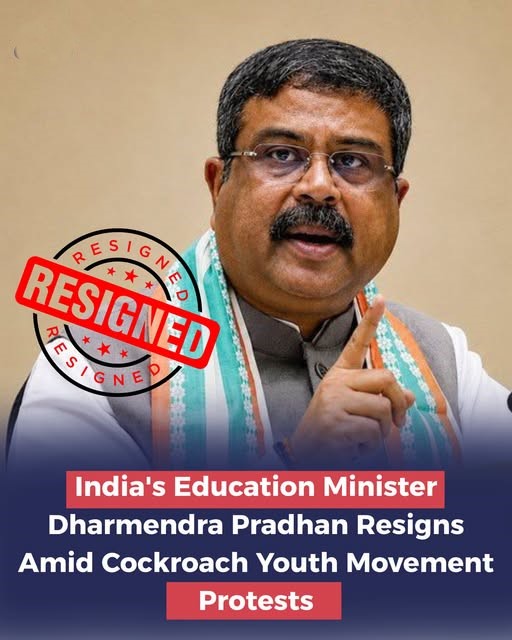
Dharmendra Pradhan Resigns: Inside the Gen Z Movement That Brought Down India’s Education Minister
By: Javid Amin | 25 July 2026
A meme-turned-movement, a Ladakhi monk-engineer’s hunger strike, and a month of anger over NEET finally claimed a Cabinet minister’s job
The Resignation That Nobody Saw Coming — Until Everyone Did
On Saturday, July 25, 2026, Union Education Minister Dharmendra Pradhan announced that he had resigned from the Union Council of Ministers and sent his resignation letter directly to Prime Minister Narendra Modi. For a government that had spent nearly two months dismissing student protests as a fringe, socially-engineered agitation, this was as close to an admission of defeat as Indian politics gets.
Pradhan didn’t frame it as a fall from grace. In his letter, he cast it as a sacrifice for the “larger interest of students,” writing that he did not want India’s youth to be trapped in “a web of confusion” over exam disputes when they should be focused on their studies and their futures. It was a carefully worded exit — dignified on paper, but forced in substance. Behind the formal language was a month of relentless pressure from an unlikely source: a protest group that named itself, half-jokingly, half-defiantly, the Cockroach Janta Party (CJP).
This is the story of how a satirical social media movement, a 20-day hunger strike by a globally recognised innovator, and the grief of grieving families turned a routine entrance-exam scandal into the biggest political reckoning India’s education ministry has seen in years.
How It Started: The NEET-UG 2026 Paper Leak
To understand why Pradhan’s resignation matters, you have to go back to the exam itself. NEET-UG — the National Eligibility cum Entrance Test for undergraduate medical admissions — is the single most consequential exam in the lives of nearly two million Indian students every year, all competing for roughly 130,000 medical seats. For most aspirants, it is not just an exam; it’s years of coaching, family savings, and personal identity riding on one test day.
When reports emerged that questions from the 2026 exam had been leaked or improperly shared before candidates sat for it, and that irregularities had also crept into the CBSE’s on-screen marking process, the exam was cancelled — a decision that instantly threw the futures of lakhs of students into uncertainty. In the days that followed, deeply disturbing reports surfaced of NEET aspirants dying by suicide, unable to cope with the sudden collapse of years of preparation and hope. That human toll, more than any bureaucratic failure, is what transformed a testing controversy into a national reckoning.
By the time results were finally declared on July 16, Pradhan tried to frame the outcome as vindication — pointing out that many meritorious students, including candidates from economically weaker backgrounds, had still succeeded. But for a movement already built on grief and anger, that framing landed as tone-deaf rather than reassuring.
Enter the Cockroach Janta Party: Gen Z’s Answer to Political Apathy
If you’re unfamiliar with the name, you’re not alone — and that’s rather the point. The Cockroach Janta Party began in May 2026 as a piece of internet satire, created by digital strategist Abhijeet Dipke as a tongue-in-cheek commentary on how ordinary citizens are treated by those in power: dismissed, ignored, exterminated on sight — like cockroaches. What started as a meme page snowballed into a genuine youth-led political movement once NEET students needed a rallying point that didn’t carry the baggage of established parties.
Beginning June 6, 2026, the CJP — joined by established student bodies including the Students Federation of India, the All India Students Association, and the All India Students Federation — began sustained demonstrations at Jantar Mantar in New Delhi, the traditional epicentre of Indian protest culture. Their demands were simple and unwavering: accountability from the education minister over the NEET paper leak and CBSE marking failures, and structural reform in how India conducts public examinations.
What set the CJP apart from older student unions wasn’t just its irreverent branding — it was its refusal to be absorbed into any political party’s agenda. Even when opposition leaders showed up to express solidarity, CJP organisers were careful to keep the protest framed as apolitical and student-owned, a distinction that gave it credibility with a young, disillusioned electorate exhausted by both the ruling party and the opposition.
Sonam Wangchuk’s Hunger Strike: The Moment the Protest Became National News
The Jantar Mantar protests might have remained a Delhi-only story if not for the involvement of Sonam Wangchuk — the Ladakhi education reformer and climate activist known for reinventing rural schooling models and, more recently, for his own long fight for Ladakh’s constitutional protections.
On June 28, Wangchuk began an indefinite hunger strike at the CJP protest site, declaring himself an “honorary cockroach” in solidarity with the students. He fasted for close to twenty days, drawing sustained national and international media attention, before he was forcibly removed by police personnel — an image that did more to galvanise public sympathy for the students than any political speech could have.
Wangchuk’s involvement gave the protest something it previously lacked: moral authority that transcended student politics. His decades of credibility as an education reformer made it far harder for the government to dismiss the agitation as an orchestrated, opposition-backed stunt.
The March to Parliament and the Government’s U-Turn
Tensions escalated further on July 20, when CJP organisers, led by Dipke, called on supporters to march directly toward Parliament. Thousands answered the call, pushing through police barricades and heavy security despite the absence of official permission for the march. It was the kind of scale and defiance that forced the government to finally take notice — by that afternoon, organisers confirmed that the Centre had, for the first time, invited protest leaders for formal talks.
That set the stage for the endgame. Over a series of negotiation rounds, the CJP crystallised its demands into three specific asks:
- The resignation of Dharmendra Pradhan as Union Education Minister, as accountability for the NEET paper leak and CBSE marking irregularities.
- A compensation of ₹1 crore to the families of students who died by suicide in the aftermath of the exam cancellation.
- No legal action — including withdrawal of FIRs — against student protesters involved in the July 20 march on Parliament.
On July 25, Union Ministers J.P. Nadda and Jitendra Singh held a third round of talks with CJP’s Chief Spokesperson Saurav Das and National Spokesperson Ashutosh Ranka. Shortly after, Pradhan’s resignation letter went public — and within hours, the government confirmed it had given in-principle approval to the remaining two demands as well.
Inside Pradhan’s Resignation Letter
Pradhan’s own words framed the decision as a moral rather than political one. He wrote of his four-decade-long association with students, teachers, and education reform, and said his resolve throughout the crisis had been to ensure that “the country’s youth power” did not become entangled in controversy at the cost of their studies and careers. He also expressed disappointment at what he described as attempts by some to mislead students during the standoff — a veiled swipe at opposition parties he accused of trying to exploit the moment rather than resolve it.
Whatever the political framing, the optics were unambiguous: a sitting Union Cabinet minister had stepped down under direct pressure from a street protest led not by a national political party, but by a movement that began as internet satire.
Celebrations at Jantar Mantar: “A Victory for the Youth”
The reaction at the protest site was immediate and emotional. Visuals showed protesters dancing, waving the tricolour, and chanting “Vande Mataram” as news of Pradhan’s resignation spread. CJP’s Saurav Das announced the formal withdrawal of the agitation, saying the group was doing so “in good faith,” trusting that the government would honour the agreed terms within the promised timelines. Some grievances — including a demand for a public apology from Delhi Police and the Rapid Action Force over crowd-control tactics — remained pending even as the main agitation was called off.
Political reactions poured in swiftly. Samajwadi Party MP Akhilesh Yadav called the resignation “a victory for the youth.” Congress’s Rahul Gandhi used the moment to intensify his broader critique of the government, while the Congress party separately announced solidarity candlelight marches across district committees. Both mainstream opposition parties were visible throughout the standoff — though CJP organisers were notably protective of the protest’s non-partisan identity, wary of any single party being seen to “own” what they considered a student-led win.
What This Means: Key Implications
| Aspect | Impact |
|---|---|
| Education Ministry | A leadership vacuum opens at a critical juncture, just as NEET-UG reforms and NTA restructuring are most urgently needed |
| Students & Families | Relief for protesters as core demands are accepted; attention now shifts to compensation disbursal and legal withdrawal for those booked during the protests |
| Ruling Party (BJP) | Faces the optics of a Cabinet resignation under street pressure — a rare occurrence for the Modi government |
| Opposition | Congress, SP and others are framing the resignation as proof of “accountability under pressure,” seeking political mileage from a movement they didn’t create |
| Public Sentiment | The CJP’s independent, non-party-aligned identity is being widely praised as a rare example of youth-led accountability outside traditional political structures |
The Risks and Questions That Remain
Who takes over, and how? The single biggest unanswered question is succession. Whoever is appointed the next Union Education Minister inherits not just a ministry, but an active reform mandate — restructuring the National Testing Agency (NTA), rebuilding faith in exam security, and possibly reworking how NEET and CBSE conduct future assessments.
Will trust actually be rebuilt? A resignation and a compensation package address the immediate crisis, but they don’t automatically fix the structural weaknesses — leaked papers, inconsistent on-screen marking, opaque grievance redress — that caused the crisis in the first place. Students and parents will be watching whether reform is real or cosmetic.
Will the “in-principle” promises hold? CJP’s decision to withdraw its agitation was explicitly described as an act of good faith, contingent on the government delivering on compensation and legal withdrawals “within the agreed-upon timelines.” Any delay or dilution risks reigniting the protest — this time with even less patience.
Political framing battles ahead. Expect the resignation to be used by every party as evidence for their own narrative: the opposition will call it proof of government failure; the ruling party will likely frame it as responsive, accountable governance. The real test is whether the reforms outlast the news cycle.
The Outlook: A New Template for Student Politics in India
Dharmendra Pradhan’s resignation is more than a single Cabinet exit — it marks a genuinely new chapter in how political accountability can be forced in India. For decades, opposition parties have demanded ministerial resignations over exam scandals, corruption, and policy failures, almost always without success. What changed this time wasn’t the demand — it was who was making it, and how.
The Cockroach Janta Party’s success lay in refusing to be co-opted. By staying deliberately outside the umbrella of any political party, and by channelling grief over student suicides into disciplined, sustained pressure rather than partisan slogans, it built a form of legitimacy that traditional opposition movements have struggled to replicate in recent years. Sonam Wangchuk’s hunger strike added moral weight that made the movement impossible to simply wait out.
For India’s roughly two million annual NEET aspirants, the immediate crisis may be easing. But the larger questions — about the integrity of the National Testing Agency, the mental health toll of India’s high-stakes exam culture, and whether genuine reform follows political concession — are only just beginning to be asked. The government has calmed the streets for now. Whether it can calm the underlying anxiety of a generation that no longer trusts the system meant to decide its future is a far harder test still ahead.
This is a developing story. Details around the appointment of a new Union Education Minister and the implementation timeline of compensation and legal withdrawals are expected to be announced in the coming days.

