Bemina Satellite Township: NBCC Awards ₹901 Crore Housing Contract
By: Javid Amin | November 25, 2026
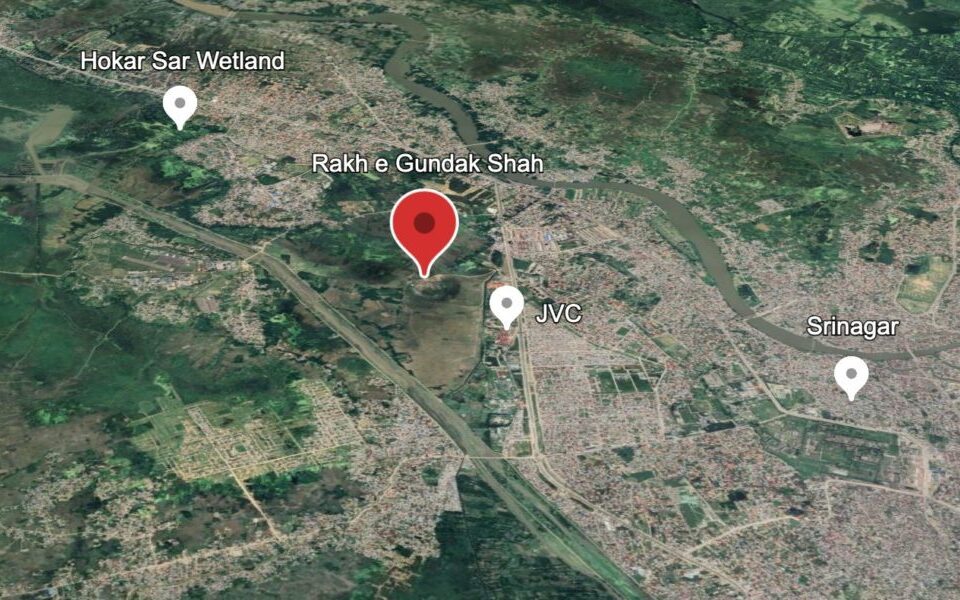
Srinagar: The ambitious Srinagar Satellite Township project at Rakh Gund Aksha, Bemina, has moved another step towards implementation, with Dilip Buildcon Limited receiving a ₹901.43-crore Letter of Award from NBCC (India) Limited for the development of Group Housing-02 and allied works.
The contract forms part of Satellite Township Phase-I, Package-3 and covers design, engineering, procurement and construction on an Engineering, Procurement and Construction (EPC) basis. The construction period is 24 months, followed by two years of operation and maintenance.
Dilip Buildcon disclosed the award to the stock exchanges on November 23, 2026. The contract value of ₹901.43 crore includes GST. The award marks a transition from the tendering process to the formal contract stage for this particular housing package, although the company’s disclosure does not specify the actual date on which construction will begin.
The development is part of a much larger urban project estimated at approximately ₹15,000 crore, planned over around 406 acres at Rakh Gund Aksha, Bemina. The township is being developed by NBCC in association with the Srinagar Development Authority (SDA).
The latest award is important not merely because of its financial size, but because it represents another step towards turning a long-planned urban development proposal into a physical residential and infrastructure project.
For Srinagar, the larger question is whether this new township can offer a planned alternative to the city’s increasingly pressured urban core.
₹901 crore contract: What exactly has been awarded?
The latest contract relates specifically to Group Housing-02, identified as Package-3 of Satellite Township Phase-I.
According to Dilip Buildcon’s stock-exchange disclosure dated November 23, NBCC awarded the company the Letter of Award for the development of the housing complex and associated works.
The contract details are as follows:
| Particular | Details |
|---|---|
| Project | Srinagar Satellite Township |
| Location | Rakh Gund Aksha, Bemina, Srinagar |
| Implementing organisation | NBCC (India) Limited |
| Awarding authority | NBCC (India) Limited |
| Contractor | Dilip Buildcon Limited |
| Package | Phase-I, Package-3 |
| Component | Group Housing-02 and allied works |
| Contract value | ₹901.43 crore, including GST |
| Execution model | EPC |
| Construction period | 24 months |
| Operation and maintenance | 2 years |
The contract is not for the entire satellite township. It is one component within the larger development programme.
The distinction matters because the ₹15,000-crore figure represents the estimated value of the overall township project, while ₹901.43 crore is the value of the specific housing package awarded to Dilip Buildcon.
The two figures should not be treated as interchangeable, nor should the latest award be described as the completion of the township’s entire construction programme.
From the lowest bidder stage to the Letter of Award
The contract followed a formal procurement process.
Dilip Buildcon had first informed the stock exchanges on November 11 that it had been declared the lowest bidder, or L-1, for the Package-3 housing works. The company subsequently disclosed on November 23 that it had received the formal Letter of Award from NBCC.
The government e-procurement record for Package-3 listed an estimated tender value of approximately ₹957.62 crore and a construction period of 720 days. The final contract disclosed by Dilip Buildcon was valued at ₹901.43 crore, including GST.
This sequence is significant because being declared L-1 is not the same as receiving a formal award. The November 23 disclosure confirms that the process progressed to the Letter of Award stage.
The contract also includes two years of operation and maintenance after the 24-month construction period. This means the company’s engagement extends beyond the physical construction phase.
Dilip Buildcon has further disclosed that its promoter group has no interest in the awarding entity and that the contract does not constitute a related-party transaction.
A ₹15,000 crore project planned across 406 acres
The Bemina satellite township is considerably larger than the recently awarded housing package.
NBCC’s own project communication records that the Srinagar Development Authority and NBCC signed a Memorandum of Understanding on August 8, 2024, for the development of a satellite township at Rakh Gund Aksha, Bemina.
The NBCC publication describes the proposed development as covering approximately 406 acres, with an estimated project value of around ₹15,000 crore. It also identifies the location as being near the proposed Medi City and High Court Complex.
NBCC’s stated role under the MoU was to take the project from concept to commissioning as Project Management and Marketing Consultant. The development was envisaged in phases over an approximately five-year schedule.
The project is therefore not simply a residential colony being constructed by a single contractor. It is a broader urban development initiative involving housing, commercial activity, public spaces and supporting infrastructure.
The scale also explains why the project is being described as a satellite township rather than an ordinary housing scheme.
What is planned inside the township?
The proposed development is expected to include a combination of residential, commercial and recreational facilities.
NBCC’s project description identifies residential plots, luxury villas, apartment complexes, commercial office spaces, an indoor sports centre and a 200-key five-star resort.
A July 2026 report by Rising Kashmir, citing the government’s project framework, also described serviced plots, multi-storeyed apartments, town homes, commercial areas, hotels, a golf course, green spaces and natural ponds.
Taken together, these descriptions suggest a mixed-use development model rather than a housing-only project.
The proposed components include:
- Residential plots and serviced plots
- Multi-storeyed apartment complexes
- Town homes and villas
- Commercial and office spaces
- Hotels and hospitality facilities
- An indoor sports centre
- A proposed 200-key five-star resort
- A golf course
- Green spaces and natural ponds
However, these are proposed project features. Their inclusion in the project vision should not be interpreted as confirmation that every facility has already received a construction contract or reached the implementation stage.
The recently awarded ₹901.43-crore package specifically concerns Group Housing-02 and allied works. It does not establish that the entire list of proposed amenities is already under construction.
Why Srinagar needs a planned urban extension
Srinagar’s urban expansion has created growing pressure on land, housing, transport and public infrastructure.
The city’s established residential areas face constraints associated with limited land availability, increasing population, rising property costs and the spread of development into peripheral areas.
As residential demand grows, construction activity often extends beyond areas where roads, drainage, sewerage, public transport and other civic facilities have been planned together.
This creates a familiar urban problem: houses and commercial buildings appear faster than the infrastructure required to support them.
The result can be congestion, inadequate parking, pressure on water supply, drainage problems and longer commuting times.
A planned satellite township offers an opportunity to approach urban expansion differently.
Instead of allowing housing to develop independently of infrastructure, the township model seeks to coordinate residential construction with roads, utilities, commercial facilities and open spaces.
If properly implemented, this could create a new urban centre that accommodates a share of Srinagar’s future population and economic activity.
The township’s location near the proposed Medi City and High Court Complex could also support the emergence of a wider institutional and residential growth corridor in Bemina.
But geographical proximity alone will not guarantee successful urban development. Transport links, public services and the timing of infrastructure delivery will determine whether the new area functions as a genuine urban extension.
Who will get the houses? The question that needs a clear answer
One of the most important public questions surrounding the project concerns the intended beneficiaries.
Will the housing be available to government employees? Will middle-income families be able to purchase apartments? Will there be provisions for economically weaker sections? Will local residents receive any preference?
These are legitimate questions, especially given the scale of the project and the public interest attached to the development of land in Srinagar.
However, the available project and contract disclosures do not establish a final allotment policy or a confirmed beneficiary-wise distribution of housing units.
The possibility that government employees, middle-income households or other categories may be considered should not be presented as an approved allocation arrangement without an official notification.
The government and the Srinagar Development Authority will need to clarify the proposed eligibility criteria, pricing structure, application process and allotment mechanism.
A transparent housing policy will be particularly important if the township is expected to address Srinagar’s housing shortage rather than simply create another premium real-estate destination.
The public will also want to know whether apartments will be sold at market rates, offered under affordable housing schemes or distributed through a combination of public and private allocation arrangements.
Until these details are formally announced, the question of who will actually benefit from the project remains open.
A self-sustainable township: What does the model mean?
The project has been described as being developed on a self-sustainable model, with NBCC serving as the Project Executing Agency.
In July 2026, Rising Kashmir reported that the government had strengthened the Empowered Committee overseeing the project by inducting two senior engineers as co-opted members.
The report also stated that the government order governing the committee had been modified to include the additional technical members.
The involvement of an empowered oversight committee is important because a development of this scale requires coordination across multiple departments and technical disciplines.
A self-sustainable model generally aims to make the development function through an integrated combination of residential, commercial and other revenue-generating components. However, the precise financing arrangements, revenue model, land monetisation mechanism and allocation of project costs should be understood from the detailed government and NBCC documents.
The ₹15,000-crore estimate should not automatically be described as a direct government budget allocation. It is the estimated value of the overall development project.
Likewise, the role of NBCC as project executing agency or project management and marketing consultant should be distinguished from the individual construction contracts being awarded to contractors.
This distinction is important for understanding who is responsible for planning, managing, constructing and maintaining different components of the township.
Sustainability and environmental safeguards cannot be an afterthought
One of the stated objectives of the project is to incorporate sustainability standards.
NBCC’s original project communication identified the possibility of pursuing GRIHA or IGBC certification, both of which are associated with green building and environmental performance.
The proposed inclusion of green spaces and natural ponds also forms part of the project’s stated vision.
These commitments will matter particularly in the context of Srinagar’s environmental sensitivity.
Urban expansion in the Valley needs to be assessed not only in terms of housing supply and commercial development, but also in relation to drainage, water management, flood resilience, natural drainage channels and the protection of environmentally sensitive areas.
The presence of natural ponds in the project concept is not, by itself, proof that environmental risks have been addressed. What matters is how the master plan identifies existing water bodies, drainage routes and ecological features, and how those elements are protected during construction and after the township becomes operational.
The administration should make relevant environmental assessments, land-use approvals and sustainability conditions accessible to the public.
It should also clarify the safeguards governing stormwater drainage, sewage treatment, groundwater use, solid waste management and the protection of existing natural features.
A township that creates new housing but adds pressure to the region’s water and drainage systems would undermine its own purpose.
Connectivity will determine whether it becomes a functioning satellite city
A satellite township cannot succeed simply by constructing residential blocks.
Its residents must be able to travel conveniently to workplaces, schools, hospitals, markets and other parts of Srinagar.
The proposed township’s proximity to the Medi City and High Court Complex gives the location potential for institutional and residential development. But its long-term success will depend on the quality of road access, public transport, parking, pedestrian facilities and links with the existing city.
If most residents are forced to depend on private vehicles, the township could add to traffic congestion rather than reduce it.
Public transport planning should therefore be integrated into the development from the beginning.
The administration will also need to consider the capacity of existing connecting roads and the additional traffic that may be generated by residential, commercial, hospitality and institutional activity.
A properly planned transport network would help the township function as an independent urban centre while remaining connected to Srinagar’s main employment and service areas.
Will the project create employment and business opportunities?
A project of this scale can generate economic activity over several years.
Construction contracts create demand for engineering, skilled labour, building materials, transport, equipment and support services. The development of commercial spaces, hospitality facilities and residential areas can also generate longer-term opportunities for businesses and service providers.
The latest ₹901.43-crore award is expected to involve a substantial construction programme, although the exact number of workers and local employment opportunities has not been specified in the company disclosure.
The wider township could create opportunities in retail, maintenance, hospitality, facility management, construction services and other sectors if the proposed commercial and residential components are implemented.
But employment benefits should not be assumed automatically. The administration and project authorities should disclose how local contractors, workers, suppliers and small businesses can participate in the project.
Local participation would help ensure that the economic benefits of a major development are not confined to the principal contractors and large commercial operators.
The concerns that must be addressed before the township expands
The scale of the Bemina project makes public scrutiny essential.
The first concern is land. The government should clearly explain the land ownership, acquisition history, land-use permissions and any rehabilitation or compensation arrangements relevant to the project.
The second is affordability. A township estimated at ₹15,000 crore could become an important source of housing, but the number of units alone will not determine whether it benefits ordinary families. Pricing, eligibility and allotment rules will matter just as much.
The third is environmental protection. The project should demonstrate how its design will manage water, drainage, natural ponds, green areas and flood-related risks.
The fourth is connectivity. Additional housing and commercial development will bring more traffic. Roads and public transport must be developed alongside the buildings rather than treated as a later requirement.
The fifth is public accountability. Residents should have access to the master plan, implementation schedule, project approvals, environmental conditions and progress reports.
These questions do not diminish the value of the project. They are essential to ensuring that the township fulfils its stated objectives.
What the latest contract tells us about the project’s progress
The ₹901.43-crore award is a concrete milestone, but it should be understood within the larger sequence of project development.
The MoU between NBCC and the Srinagar Development Authority was signed in August 2024. The broader township was estimated at approximately ₹15,000 crore and planned across around 406 acres.
The project subsequently moved through planning, tendering and institutional oversight stages. In 2026, the government strengthened the Empowered Committee overseeing implementation. NBCC then floated construction packages for Phase-I, including the Group Housing-02 package awarded to Dilip Buildcon.
The November 23 Letter of Award confirms that Package-3 has progressed beyond the initial lowest-bidder stage.
The next milestones will include the commencement of construction, the implementation of associated infrastructure, progress on other packages and the publication of clear information about the township’s housing and allotment arrangements.
The construction schedule will also need to be monitored against the 24-month period specified in the contract. The company disclosure confirms the contractual period but does not announce a specific start date.
The bigger question: Can Bemina become a new urban centre for Srinagar?
The Bemina Satellite Township is one of the most ambitious urban development initiatives proposed for Srinagar in recent years.
Its estimated scale, mixed-use development concept and location near emerging institutional infrastructure give it the potential to create a new centre of residential and commercial activity.
For a city facing growing pressure on land and infrastructure, a properly planned urban extension could offer long-term benefits.
But the difference between a satellite township and an expensive housing complex lies in the quality of planning and public access.
The project must deliver more than apartments and commercial buildings. It must provide reliable water supply, sewerage, drainage, electricity, transport, public spaces and social infrastructure. It must also make its housing accessible to the people it is supposed to serve.
The ₹901.43-crore contract awarded to Dilip Buildcon is an important step in that direction. The real measure of success, however, will be whether the larger ₹15,000-crore vision translates into an affordable, environmentally responsible and well-connected urban community.
Srinagar does not simply need more buildings. It needs better-planned growth. The Bemina township now has an opportunity to demonstrate what that can look like.