JKSSB Sticks to November 29 SI Exam Amid FAA Cheating Row, Protests and Growing Questions Over Recruitment Fairness
By: Javid Amin | 27 November 2026
The decision to go ahead with the Jammu and Kashmir Police Sub-Inspector examination has brought a recruitment controversy into sharper focus, with thousands of aspirants caught between an important career opportunity and growing concerns over the credibility of competitive examinations.
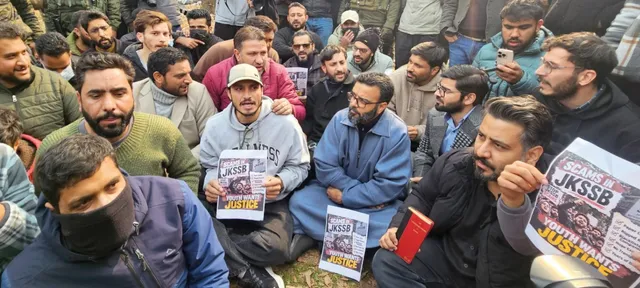
The Jammu and Kashmir Services Selection Board (JKSSB) has confirmed that the Sub-Inspector (SI) written examination will be held on November 29 as scheduled, despite protests by candidates seeking postponement following allegations of organised cheating during the Finance Accounts Assistant (FAA) examination held on November 15.
The dispute is no longer confined to whether a question paper was leaked. It has grown into a wider debate about examination security, institutional accountability, the treatment of honest candidates and whether the recruitment system can maintain public confidence when allegations of malpractice emerge.
With the controversy drawing political attention and candidates approaching the Central Administrative Tribunal (CAT), the administration is facing a difficult balancing act: protect the recruitment schedule without appearing to dismiss legitimate concerns about fairness.
The Tribunal has declined interim relief seeking postponement of the SI examination. However, that decision does not amount to a final judicial determination that every allegation surrounding the FAA examination is unfounded.
FAA examination controversy: What happened on November 15?
The FAA examination, conducted on November 15, 2026, was one of the major recruitment tests in Jammu and Kashmir, drawing a huge number of candidates competing for a limited number of government vacancies.
According to JKSSB, 1,61,946 candidates were scheduled to appear for 600 Finance Accounts Assistant posts across 493 examination centres in all 20 districts of Jammu and Kashmir. The scale of the examination alone highlights the pressure surrounding government recruitment, where a single selection list can determine years of preparation and the future prospects of thousands of families.
The controversy surfaced after police reportedly uncovered attempts to use sophisticated electronic equipment to facilitate cheating. Reports and official statements referred to modified wireless devices and miniature magnetic earpieces allegedly used as part of a cheating operation.
The incident triggered an immediate wave of concern among candidates. While the authorities maintained that the attempt had been detected and foiled, aspirants began questioning whether the alleged operation was limited to specific individuals or locations, or whether investigators could uncover a wider network.
That distinction is central to the dispute.
An isolated cheating attempt, successfully intercepted, would not necessarily invalidate an examination conducted across hundreds of centres. But if the investigation establishes that malpractice was coordinated, widespread or capable of giving candidates an unfair advantage, the consequences could extend well beyond those directly caught.
JKSSB has maintained that the FAA examination was not compromised and that the incident did not affect the overall integrity of the test. It described the alleged incident as isolated and credited police action with preventing the examination process from being undermined.
Yet for candidates seeking answers, the Board’s reassurance has not entirely resolved the concerns.
Alleged cheating attempt leads to arrests and investigation
The controversy intensified following reports that police had arrested 20 people in connection with the alleged cheating operation, including six government employees.
The arrests raised further questions about the methods allegedly used, the role of individuals involved in facilitating the cheating, and whether the investigation could identify the full chain of people responsible.
The case has also moved into the legal arena. Candidates approached the Central Administrative Tribunal, Srinagar Bench, seeking intervention over the FAA recruitment process and requesting postponement of the upcoming Police Sub-Inspector examination.
The applicants reportedly argued that the allegations warranted a deeper investigation and independent scrutiny before another major recruitment examination was conducted. They expressed apprehension about the fairness of the process and sought safeguards for candidates who had prepared honestly.
The authorities, meanwhile, maintained that the reported irregularities were localised and that swift action had been taken. The Board also informed the Tribunal about the security measures and additional protocols introduced to prevent similar attempts in future examinations.
The broader question remains whether the police investigation will establish that the alleged malpractice was limited to particular individuals or whether evidence will emerge of a more extensive operation.
That question cannot be settled by political statements, public assurances or the mere registration of FIRs. It depends on evidence, investigation findings and the examination of records.
Omar Abdullah defends JKSSB, says paper was not leaked
The political dimension of the controversy grew after Chief Minister Omar Abdullah defended the Board during a public gathering in Bani, Kathua, on November 27.
Omar said he had examined the matter and concluded that the examination system had worked, arguing that attempts to cheat should not automatically be treated as evidence of a paper leak.
He acknowledged that individuals allegedly tried to use question papers and wireless communication to obtain outside assistance, but said they were caught before they could succeed.
The Chief Minister accused political opponents of exploiting the anxieties of unemployed youth and attempting to create distrust in recruitment institutions for political gains. He argued that the authorities should be recognised for detecting the alleged cheating attempt rather than condemned without evidence of a widespread leak.
His position is straightforward: a cheating attempt was made, but the paper was not leaked and the recruitment process was not compromised.
That argument, however, has not fully settled the matter for protesting aspirants. Candidates demanding postponement are not necessarily arguing that a proven statewide paper leak occurred. Their concerns centre on whether the available evidence is sufficient to establish the extent of the alleged malpractice and whether the recruitment process can continue without further scrutiny.
The distinction matters. The existence of an alleged cheating attempt and the question of whether the examination was compromised at a wider level are two separate issues. The latter remains dependent on investigative evidence.
CAT refuses postponement, but the FAA controversy remains unresolved
The legal proceedings have added an important layer to the story.
Candidates approached the Central Administrative Tribunal, Srinagar Bench, in Original Application No. 1326/2026, seeking interim relief over the FAA recruitment and postponement of the November 29 Police SI examination.
On November 26, the Tribunal declined to grant the requested interim relief. This allowed JKSSB to proceed with the SI examination as scheduled and continue the FAA recruitment process for the time being.
But the order should not be interpreted as a clean bill of judicial approval for the FAA examination.
The Tribunal reportedly did not make a final determination on whether the examination had been compromised. It also directed the authorities to preserve relevant physical and electronic records, including OMR sheets, CCTV footage available from centres, biometric records, examination-centre logs and question-paper custody records.
The respondents have been given four weeks to submit their replies, while the matter is listed for further consideration on February 24, 2027.
The preservation of records is significant. It ensures that material potentially relevant to examining the allegations remains available rather than being lost as the recruitment process moves forward.
For the candidates seeking intervention, the legal battle is therefore not over. The immediate request for postponement was rejected, but the wider concerns about the FAA examination are still awaiting a fuller examination.
JKSSB introduces stricter security measures for the SI examination
As the controversy unfolded, JKSSB announced additional security arrangements for upcoming examinations, including the November 29 Sub-Inspector test.
The measures reflect the Board’s recognition that examination malpractice is evolving, particularly with the use of electronic devices and technology that can potentially bypass conventional frisking and surveillance.
According to the Board’s November 26 press note, the revised safeguards include:
-
Randomised deployment of invigilators through Deputy Commissioners from identified staff pools.
-
Random allocation of examination centres to candidates.
-
Reduced admit-card download window, from seven days to three days before the examination.
-
Enhanced frisking under police supervision, with magistrates overseeing entry and security arrangements.
-
Increased deployment of electronic jammers in examination halls.
-
CCTV surveillance at examination centres, with live monitoring from JKSSB control rooms in Jammu and Srinagar.
-
Mandatory deposit of mobile phones and electronic gadgets by examination staff.
-
Deployment of permanent government employees for centre-preparation duties instead of temporary or need-based staff.
-
Flying squads to inspect examination centres and nearby areas.
-
Restrictions on movement around examination centres, supported by police deployment.
-
Restrictions on metallic articles, watches, special goggles and clothing that could potentially conceal electronic devices.
The Board has also directed that unused question booklets and OMR sheets belonging to absent candidates be counted, packed and sealed under CCTV surveillance, strengthening the chain of custody for examination material.
These arrangements are intended to close loopholes that may be exploited by cheating networks. But their effectiveness will ultimately depend on how consistently they are implemented on the ground, not simply how extensively they are listed in official notices.
Why the SI examination is being held despite demands for postponement
For JKSSB, postponing another major recruitment examination carries its own consequences.
Thousands of candidates have already invested time and money in preparation, travel arrangements, coaching and application processes. A last-minute deferment could disrupt schedules and add another layer of uncertainty to recruitment, which has already been a source of frustration for many job seekers.
The Board’s position appears to be that the alleged FAA cheating attempt should not automatically derail an unrelated examination, particularly when additional safeguards have been introduced and the Tribunal has declined interim relief.
Candidates opposing the decision, however, argue that public confidence is equally important. When allegations of cheating surface just days before another high-stakes test, authorities need to demonstrate that their safeguards are credible, independently verifiable and strong enough to prevent a repeat.
The disagreement is not simply about the date of an examination. It is about which approach better protects candidates: keeping recruitment on schedule or pausing when confidence in the system is shaken.
With the Tribunal refusing to intervene at this stage, JKSSB has opted for continuity, backed by enhanced security arrangements.
The deeper issue: Trust in government recruitment
For young people in Jammu and Kashmir, government recruitment is often far more than a competitive examination. It represents financial independence, stability, social mobility and the possibility of building a future without leaving home.
That is why even a limited incident of alleged malpractice can generate widespread anxiety. When nearly 1.62 lakh candidates compete for 600 posts, the margin between selection and rejection can be extremely narrow. Any suspicion that someone may have gained an unfair advantage carries enormous emotional and practical consequences.
The challenge for recruitment authorities is therefore not merely to catch those using unfair means. It is to ensure that honest candidates have confidence that the system is protecting their efforts.
Previous recruitment controversies in Jammu and Kashmir have made that task more difficult. Each new allegation is viewed against a backdrop of accumulated public scepticism, making official assurances alone less effective in restoring trust.
A credible recruitment system needs several things working together: secure question-paper handling, transparent investigations, accountability for staff, technology-resistant examination arrangements, timely communication and, when necessary, independent scrutiny.
If irregularities are established, action must be swift and proportionate. If allegations are found to be unsupported, authorities should explain the findings clearly and provide evidence-based reassurance rather than relying solely on dismissals of criticism.
The credibility of an examination is ultimately measured not only by whether the test takes place, but also by whether candidates believe the results reflect merit.
November 29 test will be a major test of JKSSB’s credibility
The Sub-Inspector examination will now proceed on November 29, with the Board’s revised security arrangements under scrutiny.
For the candidates, the immediate priority is to sit the examination and compete on a level playing field. For JKSSB and the government, the responsibility goes further. They must ensure that the test is conducted without security lapses, that any suspicious activity is promptly investigated and that candidates are not left questioning the fairness of the process after the results are announced.
The FAA controversy is still unfolding. The arrests, the ongoing investigation, the Tribunal’s directions to preserve examination records and the pending legal proceedings mean that several important questions remain unanswered.
The decision to proceed with the SI examination may prevent another recruitment delay, but it will not by itself restore confidence.
That will require something more lasting: a recruitment system in which fairness is not simply promised by officials, but demonstrated through transparent procedures, credible investigations and accountability.
For thousands of young aspirants in Jammu and Kashmir, that is the assurance that matters most.