Sheshnag Lake Controversy: Omar, Mehbooba Clash Over BRO Work
Environmental concerns along the Amarnath Yatra route turn into a political confrontation in Jammu and Kashmir, with the Chief Minister defending the government’s position and the PDP chief demanding an independent assessment of alleged excavation near the Himalayan lake.
By: Javid Amin | 27 November 2026
The controversy surrounding alleged excavation and construction activity near Sheshnag Lake in south Kashmir has developed into a fresh political confrontation between Chief Minister Omar Abdullah and PDP president Mehbooba Mufti, bringing environmental protection, religious sensitivities and political accountability into the spotlight.
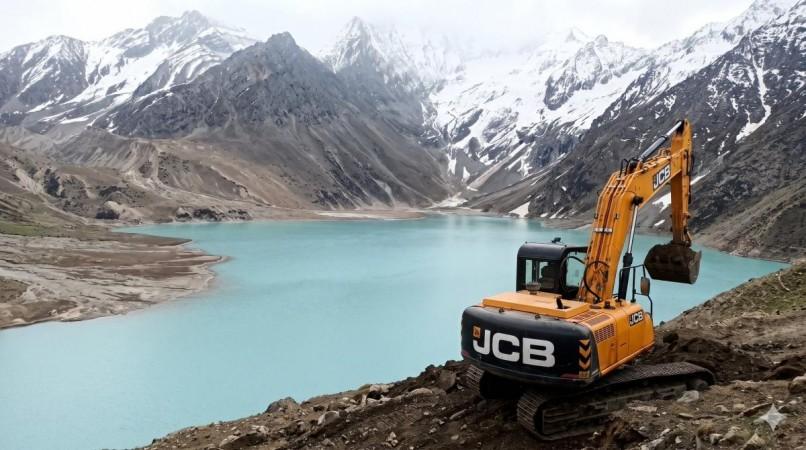
What began with reports and photographs of earth-moving machinery operating in the vicinity of the ecologically sensitive lake along the Amarnath Yatra route has now become a debate over the government’s handling of development activity in a fragile Himalayan environment.
Omar Abdullah has accused the BJP and the PDP of attempting to give a communal colour to an issue that, according to him, should be examined through environmental and administrative facts. He has maintained that government agencies have already clarified their position and that political parties should not exploit the controversy to create social divisions.
Mehbooba Mufti, however, has rejected the government’s apparent reassurance as insufficient. Pointing to what she described as visible excavation activity and JCB machines operating near the lake, she has demanded that the administration immediately dispatch an independent team to assess the actual situation on the ground.
The disagreement raises a question that goes beyond the political exchanges: Has the fragile environment surrounding Sheshnag Lake been adequately protected during development work, and can the government establish that through an independent, transparent assessment?
For a region where glaciers, alpine lakes and mountain ecosystems are already under pressure from climate change, tourism and infrastructure expansion, the answer carries implications well beyond the present political controversy.
How the Sheshnag Lake controversy began
The location quickly became a subject of public concern because Sheshnag is not an ordinary construction site. It is a high-altitude alpine lake situated along the traditional trekking route from Pahalgam to the Amarnath cave shrine.
The visuals attracted criticism from political leaders, environmental activists and sections of the public, who questioned why heavy machinery was being deployed in such a fragile landscape.
Former Srinagar MP Aga Syed Ruhullah Mehdi criticised the activity, saying Kashmir’s mountains should not be treated as private property. CPI(M) leader and MLA M.Y. Tarigami also demanded that the details of the project be made public.
The controversy gained further political momentum when Mehbooba Mufti attempted to visit the site on November 24, accompanied by PDP leaders, including Waheed Para. Police stopped her at Chandanwari, citing security concerns.
Her inability to reach the lake became another point of contention, with the PDP questioning why political representatives and people concerned about the environment were being prevented from inspecting the area.
The episode transformed what could have remained a technical dispute over track maintenance into a wider debate about transparency, access and accountability.
What exactly is the government and BRO doing near Sheshnag?
The Border Roads Organisation (BRO), which operates under the Ministry of Defence, has defended the work, describing it as part of post-Amarnath Yatra maintenance and track-widening operations.
In its November 23 statement, BRO said the work was being carried out in accordance with applicable safety norms and environmental safeguards.
According to the organisation, the objective is to improve vulnerable stretches of the existing pilgrimage tracks, stabilise slopes and provide safer passage for pilgrims and personnel during the annual Amarnath Yatra.
BRO has also maintained that the work is confined to existing tracks rather than involving the creation of a new road to the lake.
It said precautions were being taken to ensure the safe disposal of excavated material, protect natural drainage channels and minimise disturbance to the surrounding terrain.
This is an important part of the government’s defence. The authorities maintain that improving access along an existing pilgrimage route should not automatically be interpreted as constructing a new road through an untouched ecological zone.
However, the BRO statement has not, by itself, answered every environmental question raised by critics.
In particular, questions remain about the exact location of the excavation, the quantity of earth moved, the distance between the machinery and the lake, the disposal of excavated material and the environmental permissions applicable to the work.
The distinction between maintaining an existing track and carrying out fresh construction is central to the dispute. The actual work, its approved scope and its environmental safeguards need to be examined together.
Government inspection says Sheshnag Lake is safe
The Jammu and Kashmir government has rejected allegations that the work has damaged the lake.
Forest, Ecology and Environment Minister Altaf Ahmad Kaloo, also reported as Altaf Ahmad Wani in some coverage, said on November 25 that a team of 12 officials from his department had inspected the location.
According to the minister, the inspection found no evidence of excavated soil entering the lake.
He publicly stated that not even a single grain of soil had entered the water body and maintained that the existing Amarnath track had not been altered in the manner alleged.
The minister also shared footage of the lake to support the government’s position.
Chief Minister Omar Abdullah had sought a report from the Forest Minister after the controversy emerged, asking the department to establish whether any deviation had taken place during the ongoing work.
Reports also indicated that officials had examined satellite imagery while assessing whether the existing track had undergone changes.
These findings form the government’s principal defence against allegations of ecological damage.
However, there is a distinction between establishing that no soil entered the lake and establishing that the surrounding ecosystem experienced no environmental disturbance whatsoever.
A proper environmental assessment must consider more than the immediate condition of the water body. It should also examine excavation, slope stability, vegetation, natural drainage and the disposal of construction debris.
The government’s inspection is therefore an important development, but publication of its detailed findings would help make the conclusion independently verifiable.
Why Sheshnag Lake is environmentally important
Sheshnag Lake is situated at approximately 3,590 metres above sea level in the upper reaches of the Lidder Valley in Anantnag district.
It is part of a wider network of high-altitude lakes and glaciers that contribute to the region’s fragile mountain environment. The surrounding landscape includes other alpine water bodies such as Sonsar, Harnag, Konnag and Harbhagwan.
The glaciers and lakes in this region also contribute to the water system feeding the Lidder stream, an important tributary of the Jhelum.
Sheshnag is among the 14 high-risk glacial lakes identified in Jammu and Kashmir. This classification makes environmental monitoring particularly important, especially when heavy machinery and excavation are involved.
Glacial lakes are vulnerable to changes in their surrounding terrain. Excavation, slope disturbance, careless disposal of earth and interference with natural drainage can potentially affect their stability.
The risks are not limited to visible damage to the water body.
Even when excavated material does not directly enter a lake, disturbance to slopes and drainage channels can create longer-term environmental problems. The extent of such risks depends on the location, geology, scale of excavation and local hydrological conditions.
This is why environmental assessments in high-altitude areas cannot be reduced to a simple visual inspection of the lake’s water.
The region’s ecological importance is also connected with its religious significance. In Hindu tradition, Sheshnag is associated with the Amarnath pilgrimage and the mythology surrounding Lord Shiva and the Amar Katha.
Consequently, the controversy has generated concern among environmental groups as well as people who regard the lake as a sacred part of the pilgrimage landscape.
The Supreme Court’s 12-foot track direction: An important distinction
One of the most important aspects of the Sheshnag controversy concerns the Supreme Court’s earlier directions regarding the Amarnath pilgrimage route.
Following the deaths of pilgrims in 2012, the Supreme Court took suo motu cognisance of safety and infrastructure arrangements along the Amarnath route.
Among its directions was the requirement to widen the tracks to at least 12 feet to improve the movement and safety of pilgrims.
However, the court also made an important qualification: development in ecologically and climatically sensitive areas must remain within permissible environmental limits.
It specifically clarified that its directions should not be interpreted as authorising the construction of a motorable metalled road in place of the existing walking tracks.
This distinction is central to the present dispute.
Omar Abdullah has invoked the 12-foot requirement to defend the work, arguing that machinery was used to shift soil away from the lake while meeting the track-widening requirement.
BRO has similarly maintained that its work is confined to existing tracks and focuses on improving vulnerable stretches.
However, the Supreme Court’s directions cannot be treated as a blanket approval for every form of construction or excavation along the route.
The relevant question is whether the work being undertaken complies with the court’s directions, the approved project scope and applicable environmental safeguards.
Mehbooba questions the MoU with BRO: Who approved the work?
Another important dimension of the controversy concerns the Memorandum of Understanding between the Jammu and Kashmir government and BRO’s Project Beacon.
On November 25, Mehbooba Mufti alleged that the Omar Abdullah-led Cabinet had approved the extension of an MoU on January 23, 2026, which she claimed effectively cleared the road project towards Sheshnag.
She demanded an explanation from the Chief Minister and the Tourism Department, questioning whether an environmental impact assessment had been conducted and whether the necessary clearances had been obtained.
The National Conference rejected her interpretation.
Party spokesperson Imran Nabi Dar described the allegation as misinformation, arguing that the MoU concerned pending and critical works on the Amarnath pilgrimage tracks, including slope stabilisation and snow clearance.
The disagreement is significant because it concerns the actual scope of the government’s agreement with BRO.
There is a difference between authorising maintenance of an existing pilgrimage track and approving a new road through a sensitive ecological area.
The complete MoU, its annexures, approved project maps and environmental conditions would help settle this dispute.
Mehbooba subsequently renewed her demand for the government to make the agreement public.
She also questioned how heavy machinery had reached the high-altitude location and who had authorised its deployment.
These are questions that cannot be answered conclusively through political statements alone.
The government can address them by publishing the relevant documents, including:
-
The January 23, 2026, MoU with BRO’s Project Beacon.
-
The approved alignment and technical drawings of the work.
-
Environmental permissions and applicable safeguards.
-
The precise scope of excavation and track widening.
-
The inspection report prepared by the Forest Department.
Transparency over these documents would help distinguish the approved project from any alleged deviation during its execution.
Omar’s communal-politics charge and the shadow of the 2008 Amarnath land row
Omar Abdullah’s Friday remarks have introduced another dimension to the controversy.
By accusing the BJP and PDP of attempting to create Hindu-Muslim discord, the Chief Minister has connected the present dispute with Jammu and Kashmir’s politically sensitive history surrounding the Amarnath pilgrimage.
The reference is particularly significant because the 2008 Amarnath land row remains one of the most consequential political and communal confrontations in the region’s recent history.
That controversy began after the government decided to transfer approximately 100 acres of forest land to the Shri Amarnathji Shrine Board for temporary facilities for Hindu pilgrims.
The decision triggered widespread protests in Kashmir, while demonstrations in support of the land transfer took place in Jammu.
The resulting confrontation divided the then state along regional and communal lines and contributed to the fall of the Congress-PDP coalition government led by Ghulam Nabi Azad.
Against this background, Omar’s warning about communal polarisation reflects his concern that an environmental and infrastructure dispute could develop into another confrontation involving religious identity.
He has also alleged that the BJP and PDP are exploiting the controversy with an eye on the upcoming Uttar Pradesh Assembly elections.
These are the Chief Minister’s political allegations, not independently established evidence of coordination between the two parties.
The PDP, meanwhile, has presented its position as an environmental accountability campaign, insisting that the government should allow independent inspection rather than dismissing concerns as political manoeuvring.
The BJP’s position and its response to the specific allegations should also be considered separately rather than assuming that every criticism of the project is driven by communal considerations.
The central issue remains whether the work near Sheshnag has followed the approved technical and environmental requirements.
What the controversy reveals about development in Kashmir’s fragile mountains
The Sheshnag dispute raises a larger question about the kind of infrastructure development appropriate for Kashmir’s high-altitude regions.
The Amarnath Yatra is an important religious pilgrimage that attracts thousands of devotees every year. Ensuring safe passage, emergency access, medical facilities and effective crowd management is a legitimate administrative responsibility.
The 2012 Supreme Court directions also underline the importance of improving pilgrim safety.
But infrastructure development in mountainous terrain requires a different approach from ordinary road construction.
The Himalayan environment is particularly vulnerable to changes in slope stability, drainage patterns and land use. Construction activities that appear limited in scale can have wider consequences depending on local geological conditions.
The problem becomes more complicated when development takes place near glacial lakes.
There are two legitimate public interests that need to be balanced:
Pilgrim safety: Existing routes require maintenance, stabilisation and suitable improvements to reduce congestion and minimise risks to pilgrims.
Environmental protection: Such improvements must not disturb sensitive glacial landscapes, damage natural drainage systems or create unnecessary pressure on fragile mountain ecosystems.
These objectives are not necessarily contradictory.
Proper engineering, environmental assessment, controlled excavation and scientific monitoring can help achieve both.
The difficulty arises when project implementation lacks transparency or when government agencies fail to communicate clearly what work is being undertaken and why.
The Sheshnag controversy demonstrates how quickly public confidence can deteriorate when images of heavy machinery circulate without a detailed explanation of the project.
A government clarification may address immediate concerns, but public confidence ultimately depends on verifiable information.
What an independent Sheshnag inspection should establish
Mehbooba Mufti’s demand for an independent inspection deserves to be examined in the context of the unanswered technical questions.
The Forest Department has already conducted an inspection, and the government has declared the lake safe.
However, the political disagreement has made a broader, independently verifiable assessment important.
A credible inspection involving environmental scientists, glaciologists, geologists, hydrologists and representatives of the relevant departments should examine several aspects.
| Area of assessment | What needs to be established |
|---|---|
| Lake condition | Whether excavation or debris affected the water body |
| Track alignment | Whether work remained within the approved existing alignment |
| Slope stability | Whether excavation disturbed vulnerable mountain slopes |
| Natural drainage | Whether water channels were obstructed or altered |
| Excavated material | Where the removed soil and debris were deposited |
| Environmental permissions | Whether all applicable approvals and safeguards were followed |
| Project compliance | Whether BRO adhered to the MoU and technical specifications |
The assessment should also include before-and-after satellite imagery, geotagged photographs, site measurements and a review of the original project documents.
Most importantly, the findings should be made public.
An independent assessment would serve both sides.
If the government’s position is correct, a transparent report would help establish that the work remained within approved limits and that the lake was not damaged.
If deviations are identified, the same process would allow corrective measures to be taken before the situation becomes more serious.
The objective should not be to establish a political victory for either the government or the opposition. It should be to protect Sheshnag and ensure that the Amarnath pilgrimage infrastructure develops responsibly.
The real test for Omar Abdullah’s government
The Sheshnag controversy has placed Omar Abdullah in a difficult political and administrative position.
His government has defended BRO’s work, cited the Forest Department’s inspection and rejected allegations of ecological damage. He has also challenged critics to approach the courts or the National Green Tribunal if they possess evidence.
At the same time, the Chief Minister has ordered an internal examination of whether BRO deviated from the approved plan.
That decision is important because it acknowledges the need to verify whether the work was executed according to the authorised scope.
However, the administration should not allow the communal-politics argument to overshadow the environmental questions.
Even if some political leaders are exploiting the controversy, that does not automatically make every ecological concern invalid.
Similarly, Mehbooba Mufti’s demand for accountability should be assessed on the evidence available, not simply accepted or rejected because it comes from the opposition.
There is a clear difference between political criticism and environmental verification.
The government has the institutional authority and responsibility to provide the relevant documents, inspection findings and technical explanations.
The opposition, meanwhile, should substantiate its allegations through evidence rather than relying solely on circulating visuals.
Conclusion: Sheshnag needs facts, not another political confrontation
The Sheshnag Lake controversy has moved rapidly from a viral video to a major political confrontation involving the Chief Minister, the PDP, the BJP and environmental concerns surrounding the Amarnath Yatra route.
Omar Abdullah believes political parties are attempting to exploit the issue to create communal divisions. Mehbooba Mufti insists that the machinery operating near the lake raises legitimate environmental questions that deserve an independent investigation.
BRO maintains that it is improving existing tracks under applicable safeguards. The Forest Department says its inspection found no soil entering the lake. Yet questions about the approved scope of work, environmental permissions and the precise nature of excavation remain important.
The Supreme Court’s earlier directions make one principle particularly clear: improving pilgrim safety cannot come at the cost of unrestricted development in environmentally sensitive mountain regions.
For Jammu and Kashmir, Sheshnag is more than a political flashpoint. It is an ecological asset, part of a wider glacial landscape and a significant location along one of the country’s most important religious pilgrimage routes.
The government should therefore publish the MoU, make the inspection findings accessible and allow a credible scientific assessment of the site.
The most important outcome of this controversy should not be a political victory for Omar Abdullah, Mehbooba Mufti, the BJP or any other party. It should be a transparent determination of what happened near Sheshnag Lake and a commitment that development will not compromise Kashmir’s fragile Himalayan environment.