Kashmir’s Business Problem Isn’t Talent or Capital. It’s Copy-Paste.
By: Javid Amin | 23 November 2026
One shop works, ten more open next door, and margins collapse for everyone. Meanwhile, sectors with real, measurable unmet demand, from cold storage to logistics, sit half-empty. A data-led look at why Kashmir’s entrepreneurs keep chasing visible success, and what they could be building instead.
Srinagar : Walk through almost any Kashmiri market town and you can read the local economy like a map of past success stories. A garment store did well, so there are now twelve. A café found a crowd, so the next street has four more with near-identical menus. A travel agency booked a good season, and by the next one the lane has a row of signboards promising the same itineraries at ever-lower prices.
Ask around, and someone will say what everyone says: “Market saturated hai.” They are half right. Specific shops are saturated. The market itself, as the numbers below suggest, is nowhere close.
The Safe-Bet Reflex Starts With the Government Job
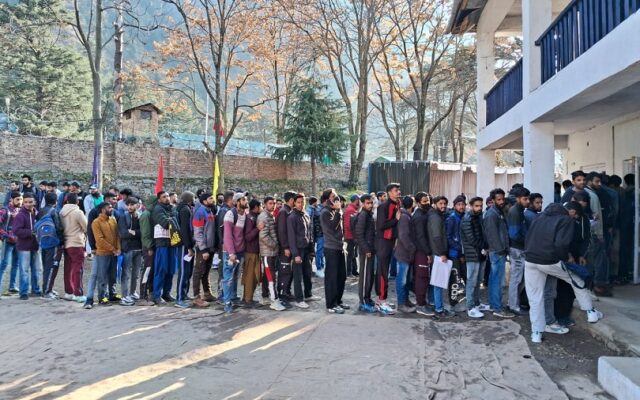
To understand why risk-taking looks so different here, start with the one career path that has long been treated as the gold standard. Between 2023-24 and 2025-26, the J&K Public Service Commission and the Services Selection Board advertised 15,964 posts and received 21,12,121 applications, according to figures placed before the Legislative Assembly. That works out to roughly 132 applicants for every advertised post, and more than 11.24 lakh candidates actually sat the exams. Over the same period, official data showed only 7,580 selections finalised since October 2024, against more than 40,000 reported direct-recruitment vacancies.
None of this means people lack ambition. It means that for a generation, the safest-looking path has been a queue, and the instinct it builds (find what is proven, avoid what is uncertain) does not switch off when someone decides to start a business instead. The question many first-time entrepreneurs ask is not “what is missing in the market?” but “what is already working for someone else?”
How Herd Entry Actually Plays Out
Economists have a name for this pattern: herd behaviour, where people copy the visible choices of others instead of doing their own analysis. It tends to flourish where information is thin and the cost of failure feels personal. Both conditions are common in small, tightly connected markets.
Consider how the cycle unfolds, as described by local traders and commentators:
- The proof appears. One outlet in a category, say readymade garments or a café format, visibly does well.
- Relatives and neighbours notice. Success is highly visible in a community where everyone knows everyone, while the groundwork behind it (location, timing, supplier terms, years of effort) is invisible.
- Entry is easy. A shop, a café or a travel desk can be replicated in weeks. A food-processing unit or a software product cannot.
- Prices fall, quality slips. With similar offerings competing for the same customers, discounting becomes the only lever, and margins shrink for the pioneer and the followers alike.
A caveat worth stating plainly: we could not find a survey that counts how many outlets of each type have opened in Kashmir, so the “20th garment shop” or “100th café” are illustrations rather than measured figures. What can be measured is the structural environment that nudges people toward the familiar, and the opportunities left untouched.
Why Caution Makes Sense, and Why It Still Costs Too Much
It would be unfair to blame mindset alone. Kashmir’s business environment carries real, repeatedly documented constraints: highway closures, harsh winters, seasonal demand swings, higher logistics costs and a long history of political uncertainty. When the downside of a bad bet is a family’s savings, choosing the familiar is rational at the individual level.
The 2025 downturn in tourism after the Pahalgam attack showed how sharply external shocks can hit even established players. But the same logic has a flip side. If everyone crowds into the same few categories, a shock to any one of them (a bad tourist season, a new competitor, a price war) hurts a disproportionate number of families at once. Diversification is not just an opportunity; it is a form of insurance for the whole local economy.
Status vs Scale: The Quiet Factor
A less-discussed driver is social. In a close-knit society, a shop with a name board is visible proof of standing: a place where relatives drop by and neighbours see you at work. An online business earning more, but invisibly, from customers who live elsewhere, does not offer the same local recognition. Entrepreneurs and mentors in the region often point to this as a reason people choose a modest, visible shop over a bigger but less visible venture. It is hard to quantify, but it echoes a theme from Kashmir’s wedding and marriage debates too: when reputation outranks return, capital flows to what looks respectable rather than what earns the most.
What the Data Says Is Actually Missing
Here is where the “market is saturated” claim falls apart. Look at what remains unfinished or underbuilt:
- Cold storage and controlled-atmosphere (CA) capacity. J&K’s CA storage has grown roughly twelve-fold since 2015-16 to about three lakh tonnes, against an estimated need of six lakh tonnes, according to a recent analysis in Kashmir Life. Apples stored in CA and sold off-season in Delhi fetched 57 to 67 percent more than fruit sold fresh at harvest. The government has also announced plans for 50,000 tonnes of additional cold storage.
- Post-harvest losses. The Centre told the Lok Sabha in 2026 that about 9.51 percent of apples in J&K are lost after harvest, which points to gaps in storage, grading, packaging and transport, each a potential business.
- Processing. Industry watchers note that a large share of the crop, including lower-grade fruit, could be turned into dried apple, juice, concentrate, jam or vinegar, products that keep longer and sell for more.
- Policy appetite. Industrial investment in J&K reached ₹5,824 crore in 2025-26, up from ₹4,145 crore a year earlier. District-level agro-processing parks in the apple belt have been proposed.
None of these require beating the next garment shop on price. They require identifying a bottleneck and building around it.
Proof That the Invisible Opportunities Pay Off
The counter-evidence to a purely pessimistic story is already visible in the Valley. Srinagar-based FastBeetle, launched in 2019 to solve last-mile delivery in a region with patchy connectivity, now handles lakhs of parcels a month and works with large e-commerce platforms, according to Forbes India and Business Standard reporting. Curve Electric introduced shared e-bikes in Srinagar and is expanding to other hill towns. Efruit Mandi, founded by a third-generation grower, is a platform to help farmers store, grade and sell produce directly to buyers. All three picked a gap (logistics, mobility, agri-trade) rather than a proven retail format.
The broader startup picture is also moving. J&K had 721 DPIIT-recognised startups in early 2024. By 31 January 2026, Assembly data cited by industry trackers put the figure at about 1,270, against a policy target of 2,000 by 2027. The Startup Policy 2024-27 promises seed funding of up to ₹20 lakh per startup and a ₹250 crore venture capital fund, with an initial ₹25 crore from the administration.
There is, though, an execution gap worth noting: seed funding is capped at 25 startups a year, which means the policy’s headline target and its actual funnel are far apart. The point is not to criticise the policy but to underline that support exists in pockets, and entrepreneurs who understand the gaps can use it, while those who copy the neighbour usually cannot.
From Shopkeeper to Producer: A Practical Shift
Taken together, the evidence suggests a few concrete changes in thinking:
- From “what is selling?” to “what is missing?” Spend a few weeks on demand research before spending lakhs on a shopfront: talk to ten customers, ten suppliers and two competitors.
- From retail to value chains. Grading, packaging, cold storage, logistics and processing sit between the grower and the consumer, and margins there are often higher than in the final shop.
- From local-only to digital-first. E-commerce, digital marketing and software services serve customers beyond the Valley’s seasonal swings. Handicraft and pashmina sectors have strong global demand, and branding and digital access are widely cited as the weak links.
- From intermediary to producer or brand. Owning the product or the platform gives more control over price than reselling someone else’s.
- From solo bets to guidance. Local chambers of commerce, incubators and startup agencies such as JKEDI can offer mentoring that most first-time owners never seek.
A famous line often attributed to Warren Buffett, about being fearful when others are greedy and greedy when others are fearful, is really about investing, but its spirit travels well. When everyone rushes toward one opportunity, the easy profit has usually already gone.
The Bottom Line
Kashmir does not lack hands, talent or ideas. What it often lacks is the habit of looking where nobody else is looking. The first shop in any category deserves credit for taking a risk. The eleventh is usually just a smaller slice of the same pie. The more valuable question, for the person with savings to invest and a family counting on them, is the one almost nobody asks aloud: what do people here need that they still can’t easily find?
This feature draws on figures placed before the J&K Legislative Assembly on JKPSC/JKSSB recruitment (via Kashmir Life, The Kashmir Images and others), Kashmir Life’s analysis of J&K’s economy beyond apples, Kashmir Vision’s report on post-harvest apple losses, Forbes India, Business Standard, Kashmir Observer, The Tribune and startup-ecosystem data on the J&K Startup Policy 2024-27. Startup counts come from secondary trackers citing Assembly data and should be checked against the official Startup India portal before publication.