The National Conference leader says allegations against mosques without credible evidence risk deepening mistrust. But the controversy also exposes a troubling information vacuum surrounding the deaths of two police personnel.
By: Javid Amin | 18 November 2026
Srinagar: The killing of two Special Police Officers (SPOs) in Jammu and Kashmir’s Kishtwar district has developed into a political controversy with implications extending well beyond the security incident itself. What began as an investigation into the deaths of two local police personnel has triggered competing allegations, questions about police accountability and a sharp exchange over the place of religious identity in the region’s political discourse.
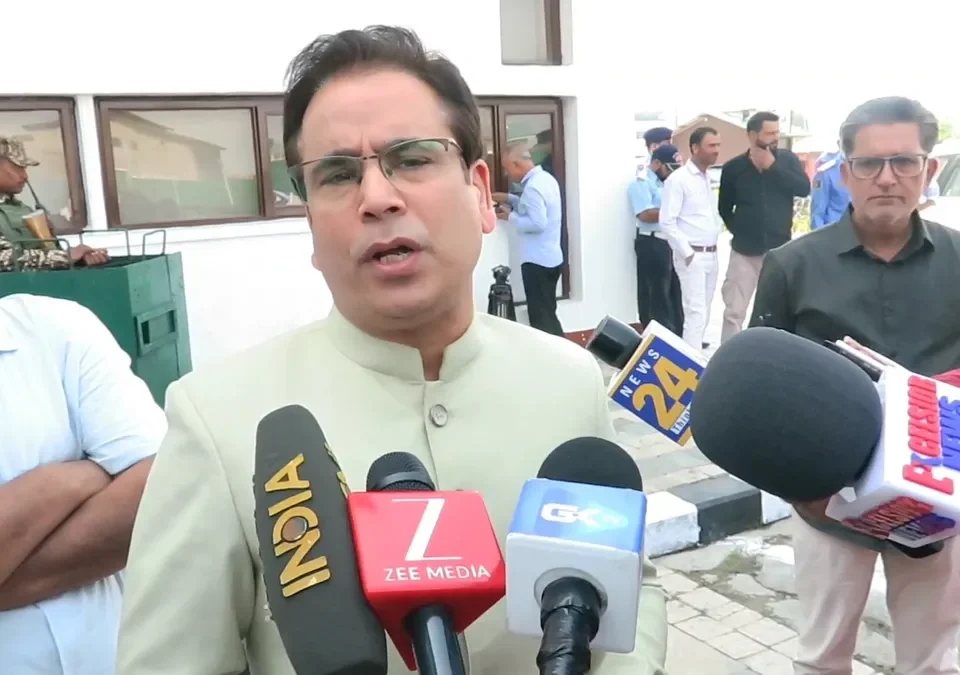
National Conference chief spokesperson and Zadibal MLA Tanvir Sadiq has accused the Bharatiya Janata Party (BJP) of repeatedly bringing religion into political debates, warning that such statements could weaken the fragile bonds of communal harmony in Jammu and Kashmir.
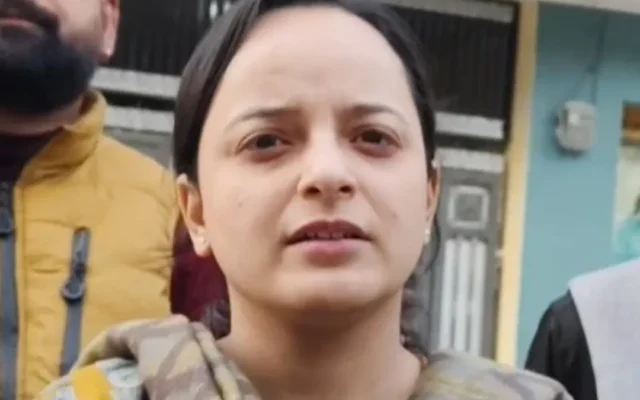
His remarks followed allegations by BJP’s Kishtwar MLA Shagun Parihar, who claimed that announcements had been made from a mosque before the killing of two SPOs in the Dachhan area. Parihar also suggested that someone was leaking information about the personnel’s movements to militants.
Sadiq described allegations against religious institutions without credible evidence as irresponsible and unacceptable. He called on the BJP leadership to distance itself from the remarks and issue an unconditional apology.
The controversy raises a fundamental question: should an unverified allegation involving a religious institution become part of the public narrative surrounding a security operation before investigators establish what actually happened?
Two SPOs killed in Kishtwar: What is known so far
The controversy centres on the deaths of SPOs Babi Chand, aged 57, and Rashpal Kumar, aged 45, both residents of Kishtwar district.
The two personnel went missing on November 11 while travelling in the Dachhan-Marwah belt. Their bodies were recovered from a forest area on November 12. Reports said they had been travelling towards a security post after leaving the Kiyar camp.
The circumstances surrounding their deaths immediately raised questions about the security arrangements in the mountainous region. The area has difficult terrain, dense forests and a history of counter-insurgency operations, making movement between security posts particularly challenging.
Initial reports citing officials said the bodies bore bullet wounds. Hindustan Times also reported that the personnel’s service weapons and ammunition were missing and that investigators had recovered empty cartridges believed to be of Pakistani origin from the scene. These details, however, do not by themselves establish who carried out the killings or the precise sequence of events.
The absence of an early, comprehensive public account from the police added to the uncertainty. The Tribune reported on November 14 that authorities had not issued a detailed statement explaining the circumstances of the deaths. Its subsequent November 17 report said competing theories were circulating without an official account confirming whether the SPOs had been killed in a militant attack or under other circumstances.
This silence matters. In a sensitive district, the absence of timely information can create space for rumours, political speculation and allegations that are difficult to contain once they spread.
The mosque allegation that triggered the controversy
The political row intensified after Shagun Parihar spoke to reporters during a wreath-laying ceremony for the slain personnel.
In a video circulated after the incident, she alleged that announcements had been made from a mosque before the killings. She questioned why those allegedly involved had not been apprehended and suggested that information about the SPOs’ movements had been leaked.
Her remarks introduced a religious institution into an incident whose circumstances had not yet been publicly established by investigators.
There are two separate allegations in her remarks that require careful examination.
The first concerns the claim that announcements were made from a mosque calling for violence. The second concerns the possibility that someone had leaked information about the personnel’s movements. Both are serious claims. Neither should be treated as established fact without evidence.
A report by The Wire noted that Parihar did not identify the mosque, specify the contents of the alleged announcements or provide supporting evidence in the remarks examined by the publication. The report also said it had sought her response.
The distinction is important. If investigators establish that a person or institution was involved in incitement or the provision of operational information to militants, those responsible must face the law. But an allegation against a mosque cannot automatically become an accusation against its congregation or the wider religious community.
A security investigation must identify individuals, establish conduct and follow evidence. It cannot rely on collective suspicion.
A BJP leader also challenges the claim
One of the most significant developments in the controversy came from within the BJP itself.
Jahanzaib Sirwal, a BJP leader from Kishtwar, publicly objected to Parihar’s mosque-related allegation, describing it as deeply unfortunate and factually unsubstantiated.
Sirwal argued that religious institutions should not be linked to provocative or unlawful activities without credible evidence. His intervention is relevant because it demonstrates that the objection to the allegation is not confined to political opponents of the BJP.
The Islami Markaz-e-Majlis Shura Kishtwar, headed by Jamia Masjid Imam Maulana Farooq Ahmad Kichloo, also rejected the claim. The organisation described the allegation as baseless and potentially damaging to communal peace, and demanded a public apology from the legislator.
These responses do not independently establish what happened before the killings. They do, however, underline the need for evidence before any religious institution is publicly implicated.
The BJP’s internal disagreement also complicates the suggestion that the controversy represents a straightforward confrontation between two political parties. A local BJP figure has himself questioned the basis of the mosque allegation.
Tanvir Sadiq’s warning: Security concerns must not become communal accusations
Reacting to the controversy, Tanvir Sadiq said every citizen of Jammu and Kashmir, regardless of religion, was entitled to dignity, justice and protection.
He accused the BJP of repeatedly introducing religious identity into political discourse and argued that such politics could damage the region’s social fabric.
Sadiq’s central point was that sensitive security incidents should be investigated by competent agencies rather than used to cast suspicion on religious institutions without substantiation.
He also referred to an earlier Assembly controversy in which the same BJP legislator was alleged to have used the description “nationalist Hindus” for residents of Kishtwar. Sadiq argued that repeated references to religious identity in public and political matters were a cause for concern.
The National Conference leader demanded that the BJP leadership publicly condemn the mosque-related remarks and apologise.
His intervention reflects the NC’s broader political position that communal harmony in Jammu and Kashmir must be protected, particularly when security incidents involve communities living in close proximity.
But the responsibility does not rest with one party alone. Every political formation has an obligation to avoid turning an unresolved criminal or security investigation into a contest over religious identity.
Congress raises a different possibility: Was it a case of mistaken identity?
The mosque allegation is not the only theory that has emerged around the killings.
Jammu and Kashmir Pradesh Congress Committee president Tariq Hameed Karra called for a thorough investigation and raised the possibility that the two SPOs could have been killed in a case of mistaken identity involving security personnel.
According to Karra, information available to him suggested that the two men had gone hunting in the forest with their weapons and may have been mistaken for militants while returning. He said there were security positions in the area and argued that all possible angles should be examined.
This is a political leader’s claim, not an established finding. It should not be reported as the confirmed explanation for the deaths.
The Indian Express subsequently reported that officials familiar with the autopsy findings said Chand had sustained two bullet wounds while Kumar had five. The reported bullet trajectories suggested different firing angles and, in Kumar’s case, multiple trajectories. The newspaper also reported that local residents and the families had raised questions about why the two SPOs were deployed outside their area of jurisdiction.
These details make a comprehensive investigation all the more necessary. They do not, on their own, establish whether the personnel were killed by militants, security forces or another actor.
The competing accounts demonstrate why investigators must examine every credible possibility, including militant involvement, intelligence leaks, mistaken identity and questions surrounding the deployment of the personnel.
Police silence has created room for speculation
Perhaps the most troubling aspect of the controversy is the gap between the seriousness of the incident and the limited information made publicly available in its immediate aftermath.
The Tribune’s reporting highlighted the absence of a detailed police account, while its November 17 analysis warned that silence was allowing competing political claims to gain traction.
The issue is not that investigators should disclose sensitive operational information or compromise evidence. That would be irresponsible. But there is a difference between protecting an investigation and leaving the public without basic verified information.
Authorities can provide a factual account of what is known, clarify what remains under investigation and correct demonstrably false claims without revealing operational details.
In the absence of such communication, political statements can begin to fill the vacuum. One side may describe the incident as a militant conspiracy; another may raise the possibility of friendly fire; a third may link it to a religious institution. Each version can acquire a public life of its own before investigators have completed their work.
That is dangerous for both public confidence and communal relations.
Kishtwar’s social balance deserves protection
Kishtwar and the wider Chenab Valley have a complex social and religious composition. Communities have shared neighbourhoods, local institutions, markets and public spaces for generations. Their coexistence should not be romanticised as free of tensions, but neither should it be treated as so fragile that unverified political allegations are allowed to define relations between them.
A mosque is a place of worship. If an individual uses it to incite violence or facilitate a crime, the law must take its course. But that responsibility must be established through evidence and directed at those actually involved.
The same principle applies to any institution, religious or otherwise. No organisation should enjoy immunity from investigation, but none should be condemned through collective suspicion.
This is where political language carries particular weight. Elected representatives have a right to question the police, demand accountability and express anger over the killing of security personnel. They also have a responsibility to distinguish between what they know, what they suspect and what they can prove.
The deaths of Chand and Kumar deserve answers. Their families deserve clarity about how the men were killed, why they were in the area and whether any security or intelligence failures contributed to the tragedy. Those questions should remain at the centre of public discussion.
The BJP leadership faces questions of accountability
Sadiq’s demand for an apology places the BJP leadership under political pressure to clarify whether it endorses the remarks made by its Kishtwar legislator.
The public objection raised by Jahanzaib Sirwal makes that question more difficult to avoid. If a party leader from the same district has described the allegation as unsupported, the BJP has reason to explain what evidence, if any, supports the original claim.
At the same time, an apology alone would not resolve the larger questions surrounding the killings. The investigation must establish the facts, and the administration must address concerns over the deployment and safety of local security personnel.
The National Conference, too, must ensure that its criticism remains focused on accountability and does not become another exercise in partisan escalation.
The issue is not whether one party wins the political argument. It is whether the truth about the deaths can be established without placing innocent people or entire communities under suspicion.
The investigation must come before the political narrative
The Kishtwar killings have exposed two interconnected problems: unanswered questions about a serious security incident and the speed with which communal allegations can enter political discourse.
There is no contradiction between demanding a strong investigation and rejecting unsupported accusations against a religious institution. Both positions are necessary for justice.
The police and other competent agencies must establish the circumstances of the killings, examine the reported ballistic evidence, investigate any possible intelligence leak and clarify whether the deployment of the two SPOs followed established procedures.
The BJP leadership should explain its position on the mosque allegation, while all political parties should exercise restraint until verifiable findings emerge.
For Tanvir Sadiq, the controversy is evidence of what he describes as the dangers of religious polarisation. For the families of the two slain SPOs, however, the immediate concern is more basic: they need to know how their loved ones died and who was responsible.
That question must not be lost in the political noise.
Communal harmony cannot be protected by suppressing legitimate security questions. Nor can justice be delivered by turning suspicion into collective blame. In Kishtwar, the way forward must begin with evidence, transparency and accountability.