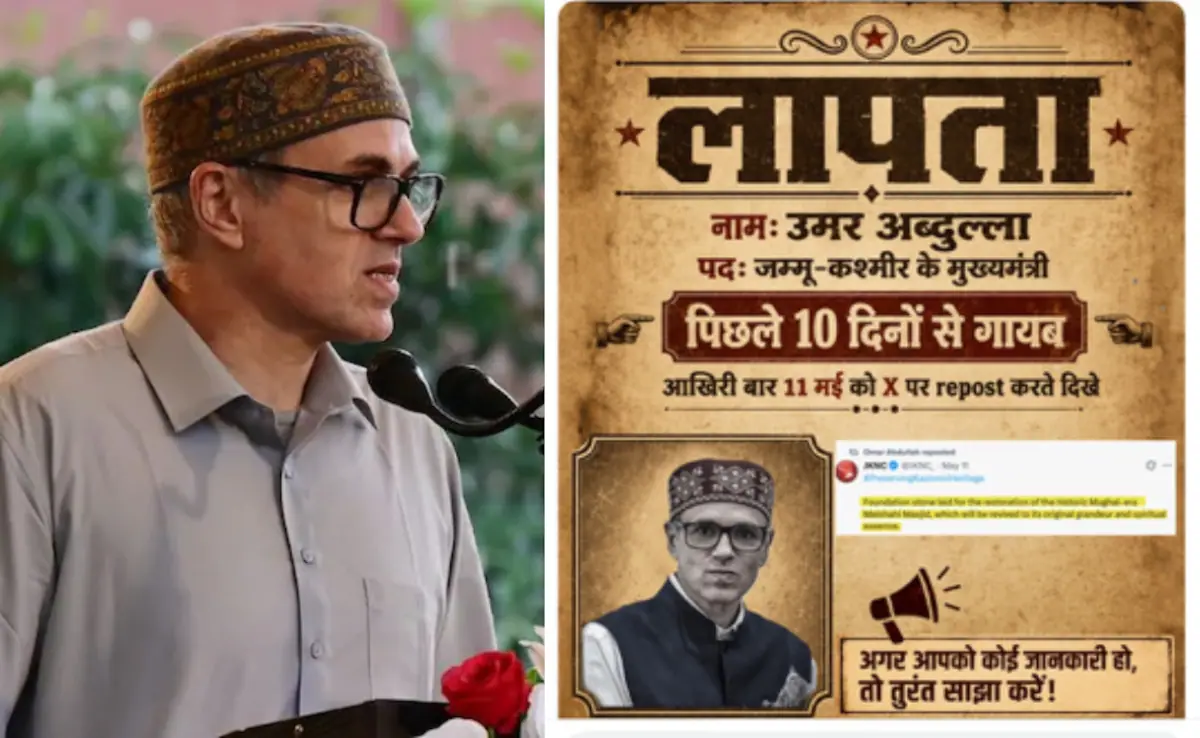
‘Missing’ Posters of Omar Abdullah Trigger Political Storm in Kashmir, Rekindle Debate Over Leadership Visibility
By: Javid Amin | 23 May 2026
National Conference Calls It a Smear Campaign; Rivals Say It Reflects Public Frustration in Post-Article 370 Kashmir
A fresh political controversy has erupted in Srinagar after “missing” posters featuring former Jammu and Kashmir Chief Minister Omar Abdullah surfaced in parts of the city, triggering sharp reactions from political parties and renewed debate over leadership visibility in the Valley.
The posters, which portrayed Omar Abdullah as “missing” from ground-level politics and public engagement, quickly became a talking point across Kashmir’s political circles and social media platforms. While leaders from the Jammu & Kashmir National Conference condemned the move as a deliberate smear campaign aimed at damaging Omar Abdullah’s image, opposition voices argued that the posters reflect growing public frustration and political disillusionment in post-Article 370 Jammu and Kashmir.
The controversy has once again highlighted the increasingly intense battle over political perception, public outreach, and credibility in the Valley’s rapidly changing political landscape.
‘Missing’ Posters Surface in Srinagar
The political storm began after posters carrying Omar Abdullah’s photograph and “missing” messaging reportedly appeared in parts of Srinagar.
The posters implied that the National Conference leader has remained absent from pressing public concerns and insufficiently visible on the ground during a period of major political and socio-economic transition in Jammu and Kashmir.
Photographs of the posters quickly circulated online, fueling debate among political supporters, critics, and ordinary residents.
While the exact individuals or groups behind the posters remain unclear, the messaging immediately drew political reactions from both supporters and rivals of the National Conference.
National Conference Condemns Posters as “Malicious Campaign”
Leaders and workers of the National Conference strongly condemned the posters, describing them as a politically motivated attempt to malign Omar Abdullah and weaken the party’s standing ahead of future electoral battles.
NC leaders argued that Omar Abdullah has consistently spoken on issues affecting Jammu and Kashmir, including:
- Restoration of statehood
- Constitutional rights
- Youth concerns
- Unemployment
- Democratic processes
- Public welfare issues
Party insiders described the poster campaign as “cheap political propaganda” intended to create an artificial perception of disconnect between the leadership and the people.
Several NC supporters also accused rival political groups of orchestrating symbolic campaigns to undermine mainstream regional parties in Kashmir.
Rivals Say Posters Reflect Public Mood
Opposition voices, however, interpreted the posters differently.
Critics argued that the “missing” narrative resonates with sections of the public who feel mainstream political leadership in Kashmir has struggled to remain visibly connected with everyday grassroots concerns following the abrogation of Article 370 in 2019.
Some political observers say many Kashmiris increasingly expect leaders to maintain stronger physical presence, public interaction, and direct engagement on issues such as:
- Unemployment
- Rising living costs
- Civic problems
- Youth frustration
- Development concerns
- Political uncertainty
Rivals of the National Conference claim that symbolic protests like these emerge when public expectations remain unmet or when leadership appears overly confined to formal political statements rather than sustained public outreach.
A Larger Debate Over Mainstream Politics in Kashmir
The controversy surrounding the posters goes beyond one political leader. It reflects a broader debate unfolding across Kashmir about the relevance, accessibility, and effectiveness of mainstream political parties in the post-Article 370 era.
Since Jammu and Kashmir’s constitutional reorganization in 2019, traditional regional parties have faced growing scrutiny over:
- Political strategy
- Ground mobilization
- Public visibility
- Engagement with younger generations
- Ability to influence governance outcomes
Many young Kashmiris today express frustration not only with governance issues but also with what they perceive as political stagnation and limited responsiveness from established leadership structures.
Political analysts say symbolic acts such as “missing” posters often emerge from deeper public dissatisfaction and emotional disconnect rather than simple partisan rivalry.
Omar Abdullah Remains One of Kashmir’s Most Recognizable Political Faces
Despite criticism, Omar Abdullah continues to remain among the Valley’s most recognizable and influential mainstream political leaders.
As vice-president of the National Conference and former chief minister, he maintains a strong political base across several parts of Jammu and Kashmir and continues to command significant media and public attention.
Over recent years, Omar Abdullah has repeatedly addressed:
- Restoration of democratic rights
- Assembly elections
- Statehood restoration
- Security concerns
- Youth engagement
- Constitutional matters
Supporters argue that attempts to portray him as politically absent ignore his continued presence in public discourse and political debates concerning Jammu and Kashmir.
Political Optics Becoming Increasingly Important in Kashmir
Analysts say the incident demonstrates how political perception and symbolism are becoming increasingly powerful in Kashmir’s evolving political environment.
In an age dominated by social media, viral imagery, and public sentiment campaigns, even symbolic acts such as posters can shape narratives quickly.
Political parties are now competing not only through speeches and policies but also through:
- Visibility
- Emotional messaging
- Public accessibility
- Social media engagement
- Street-level optics
Experts believe leaders who fail to maintain consistent grassroots engagement risk being portrayed as disconnected, regardless of their formal political activities.
Public Reactions Remain Mixed
Public response to the controversy appears divided.
Some residents dismissed the posters as political theatrics designed to attract attention and provoke controversy.
Others argued that the messaging reflects genuine frustration among people who feel political leadership across party lines has not adequately addressed everyday economic and social struggles.
Among younger voters especially, there is increasing demand for:
- More accessible leadership
- Faster response to civic issues
- Stronger public interaction
- Practical solutions rather than symbolic politics
Observers say this changing political culture is forcing traditional parties to rethink how they communicate with the public.
Risks for National Conference
Political analysts believe the controversy could create short-term image challenges for the National Conference if the “absent leadership” narrative gains wider traction.
Potential risks include:
- Pressure on party cadres to defend leadership visibility
- Increased criticism from political rivals
- Greater public scrutiny over outreach efforts
- Challenges in maintaining youth support
At the same time, some analysts believe aggressive attacks on Omar Abdullah could also consolidate support among loyal NC voters who view such campaigns as politically motivated targeting.
Likely Political Response Ahead
Observers expect the National Conference to intensify public outreach efforts in response to the controversy.
This may include:
- Greater grassroots engagement
- Public meetings and interaction campaigns
- Stronger digital outreach
- Issue-based mobilization
- Youth-focused political messaging
Meanwhile, rival political groups are likely to continue using public dissatisfaction narratives to position themselves as closer to grassroots concerns.
More Than a Poster Controversy
The “missing” poster episode ultimately reflects something deeper than a single political provocation.
It reveals:
- Public frustration
- Growing political impatience
- Demand for visible leadership
- Changing expectations from politicians
- The power of symbolic politics in modern Kashmir
In a region where politics remains deeply emotional and closely tied to everyday realities, perception often becomes as important as policy itself.
And in Kashmir’s increasingly competitive political landscape, visibility may now matter as much as ideology.


