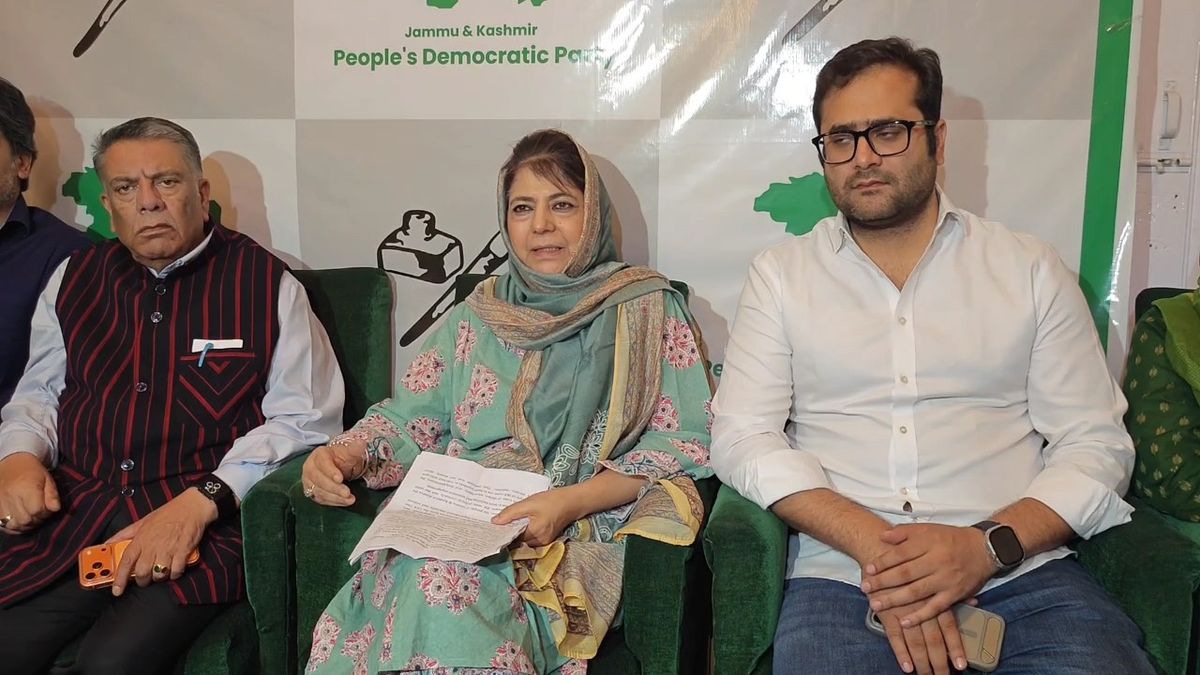
Mehbooba Mufti Urges United J&K Outreach to PM Modi, Cites Ladakh’s Breakthrough as a Model
By: Javid Amin | 02 June 2026
PDP Chief Writes to Omar Abdullah, Urges Mainstream Parties to Speak in One Voice on Constitutional Rights and Democratic Restoration
Srinagar: A major political debate is unfolding in Jammu and Kashmir after PDP president and former Chief Minister Mehbooba Mufti urged mainstream political parties to adopt a united strategy similar to the one employed by Ladakh’s civil society groups in their engagement with the Central government.
In a letter addressed to Chief Minister Omar Abdullah, Mehbooba argued that Jammu and Kashmir’s divided political approach has weakened its ability to secure meaningful political and constitutional outcomes, while Ladakh’s coordinated efforts have demonstrated the power of collective action.
Her appeal comes at a time when political discussions across Kashmir are increasingly dominated by the recent breakthrough achieved by the Leh Apex Body (LAB) and the Kargil Democratic Alliance (KDA), which have engaged the Centre on issues relating to constitutional protections, democratic representation, and regional safeguards.
Why Ladakh’s Success Has Captured Kashmir’s Attention
Over the past several months, Ladakh’s civil society groups have maintained a united campaign around key demands, including constitutional safeguards, protection of land and jobs, and democratic empowerment.
Unlike conventional political parties, the Leh Apex Body and Kargil Democratic Alliance brought together diverse political, social, religious, and community stakeholders under a common platform.
Their coordinated engagement with the Centre has resulted in what many observers describe as an important “in-principle” breakthrough, generating widespread interest throughout Jammu and Kashmir.
In Kashmir’s political circles, the development has sparked an uncomfortable question: Why has Ladakh managed to present a unified voice while Jammu and Kashmir’s mainstream parties continue to operate separately?
That question forms the core of Mehbooba Mufti’s latest political intervention.
Mehbooba’s Message: Fragmentation Has a Cost
In her communication, Mehbooba Mufti reportedly emphasized that political fragmentation has diluted Jammu and Kashmir’s bargaining power.
According to her argument, different parties may hold varying political ideologies, but issues concerning democratic rights, constitutional safeguards, statehood restoration, and institutional representation require a collective approach.
Her message appears to be directed not only at the ruling National Conference but also at the broader spectrum of mainstream political actors, including the Indian National Congress, Communist Party of India (Marxist), and other stakeholders.
The underlying theme is straightforward: when a region speaks through multiple competing voices, its demands often lose clarity and political weight.
A Direct Challenge to the National Conference
Beyond its appeal for unity, the letter places political pressure on the ruling National Conference.
Since assuming office, Omar Abdullah and the National Conference have consistently advocated for the restoration of statehood and democratic rights. However, opposition parties argue that these efforts have largely remained confined to speeches, resolutions, and public statements.
By invoking the Ladakh example, Mehbooba is effectively asking whether the National Conference is willing to move beyond party-centric politics and participate in a broader collective initiative.
Political observers view this as both a strategic challenge and a political opportunity.
If the National Conference accepts the proposal, it could help build a wider consensus on key issues affecting Jammu and Kashmir.
If it declines or remains non-committal, the PDP may seek to portray itself as the party actively pursuing collective political engagement.
The Politics Behind the Appeal
While the letter carries a message of unity, it also reflects the realities of contemporary political competition.
For the PDP, the initiative serves several purposes:
Reclaiming Political Relevance
After facing electoral setbacks and organizational challenges in recent years, the PDP is attempting to re-establish itself as a significant political voice.
A call for unity allows the party to occupy moral and political ground that transcends traditional opposition politics.
Shifting the Debate
Rather than focusing solely on party rivalries, Mehbooba’s intervention redirects attention toward larger constitutional and democratic questions.
Building Public Pressure
The appeal also places the burden of response on rival parties, particularly the National Conference, which currently leads the elected government.
Why the Ladakh Model Resonates
The comparison with Ladakh is politically powerful for several reasons.
Unified Representation
The Leh Apex Body and Kargil Democratic Alliance managed to bridge regional, ideological, and community differences to pursue common objectives.
Clear Demands
Their campaign focused on specific, clearly articulated demands rather than broader political narratives.
Consistent Engagement
Instead of episodic political statements, the Ladakh groups pursued sustained engagement with decision-makers.
For many Kashmiris, this approach is increasingly being viewed as a practical example of how collective advocacy can generate political momentum.
Can a United Front Actually Emerge?
Despite Mehbooba’s appeal, significant challenges remain.
Deep Political Rivalries
The National Conference and PDP remain competitors for much of the same political constituency in Kashmir.
Years of political confrontation have created trust deficits that cannot be overcome easily.
Different Strategic Approaches
Parties differ on the pace, methods, and priorities of engagement with the Centre.
While there may be agreement on broad objectives, differences often emerge regarding tactics.
Electoral Considerations
Political parties must also consider how cooperation might affect their individual political identities and voter bases.
As a result, building a genuinely united platform will require compromises that many parties may find difficult.
Public Sentiment: Growing Interest in Collective Action
Among ordinary citizens, however, the conversation is increasingly shifting.
The perceived progress made by Ladakh’s civil society groups has generated curiosity and, in some quarters, frustration about the absence of a comparable effort in Jammu and Kashmir.
Many political observers note that public expectations are evolving.
Voters are increasingly interested in outcomes rather than symbolism, and there is growing pressure on political leaders to demonstrate effectiveness through coordinated action.
This changing sentiment gives Mehbooba’s proposal greater relevance than it might have had in previous years.
Omar Abdullah’s Response Will Be Closely Watched
The next political development may depend largely on how Omar Abdullah and the National Conference respond.
As the head of the elected government, Omar occupies a unique position in Jammu and Kashmir’s political landscape.
Any decision to participate in a joint outreach initiative would carry significant political implications and could potentially reshape the conversation around statehood, democratic restoration, and constitutional safeguards.
Equally, a cautious or negative response could intensify debate over whether mainstream parties are capable of speaking in one voice on issues of common concern.
A Litmus Test for Mainstream Politics
The debate triggered by Mehbooba Mufti’s letter extends beyond party politics.
At its heart lies a broader question: Can Jammu and Kashmir’s political leadership overcome competition and fragmentation to pursue shared objectives?
Ladakh’s recent experience has provided a tangible example of how collective action can influence political negotiations.
Whether Jammu and Kashmir’s leaders can replicate that model remains uncertain.
What is clear, however, is that the discussion has already altered the political conversation in the region.
Conclusion
Mehbooba Mufti’s appeal for a united outreach to the Prime Minister and Home Minister is both a political maneuver and a substantive call for collective action. By invoking Ladakh’s recent breakthrough, she has highlighted what many view as a growing contrast between Ladakh’s coordinated advocacy and Jammu and Kashmir’s fragmented political landscape.
The letter places responsibility on all mainstream parties, particularly the National Conference, to decide whether common constitutional and democratic concerns can rise above electoral rivalries.
As political attention turns toward Omar Abdullah’s response, the coming days may reveal whether Jammu and Kashmir’s leadership is prepared to pursue a unified strategy—or whether divisions will continue to define the region’s engagement with the Centre.

