150 Bangladeshis Flown Out of Kashmir: Deportation Drive Puts J&K’s Migration, Security and Demography Debate Under Spotlight
By: Javid Amin | 05 October 2026
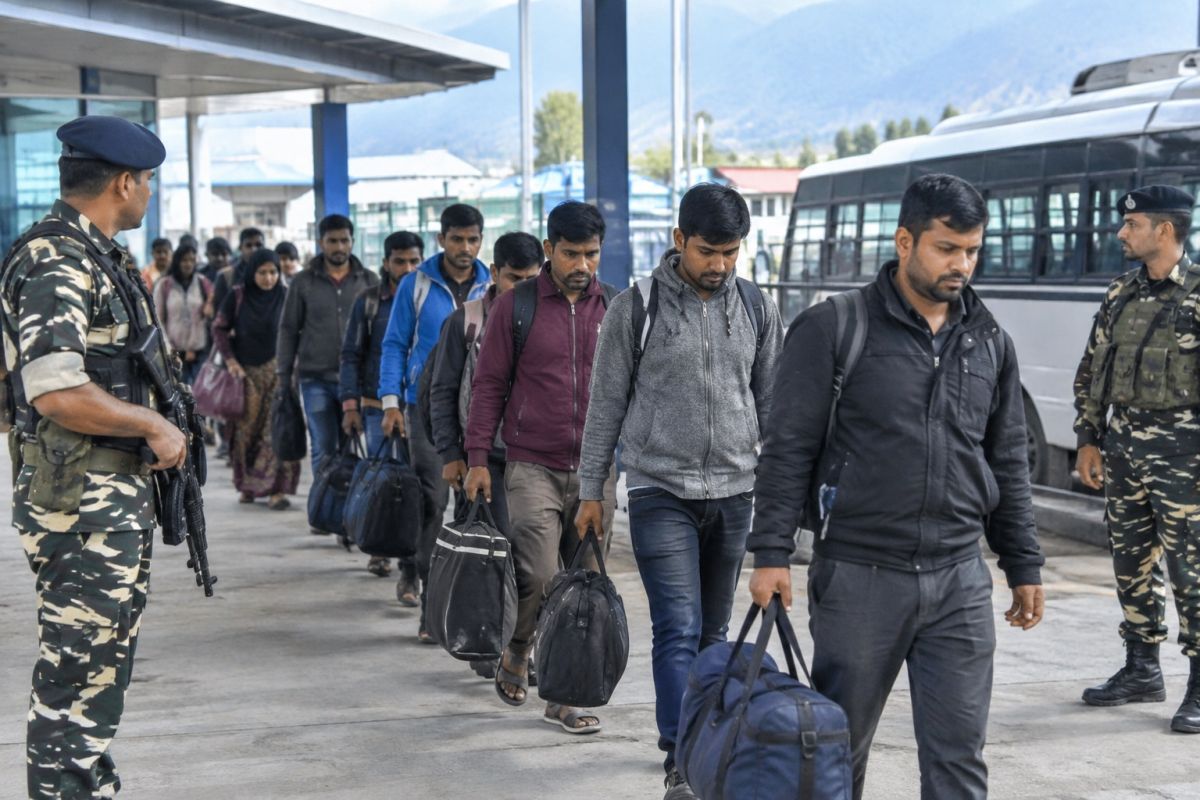
Srinagar: A new chapter has opened in Jammu and Kashmir’s long-running debate over undocumented migration. On Monday, authorities moved the first batch of 150 Bangladeshi nationals from Srinagar to Bagdogra in West Bengal on a special Indian Air Force aircraft, where they were handed over to the Border Security Force for onward repatriation to Bangladesh. Another batch of 150 is expected to be moved on October 7, according to police and government officials.
The operation is significant not simply because of the number involved. It comes after a Valley-wide verification exercise, follows the Centre’s creation of a High-Level Committee on Demographic Change, and comes at a time when official figures have put the number of identified Rohingya in J&K at 7,656 and Bangladeshi nationals at 504.
Yet there is an important distinction in the numbers. The 504 figure was presented to the central demographic committee in August, while the latest police exercise has reportedly identified around 600 Bangladeshi nationals in the Kashmir Valley alone. These are not necessarily contradictory figures because they come from different exercises and dates. The August figure was a government dataset presented to the committee, while the October figure comes from a more recent verification drive.
That distinction matters as the administration moves from identification to actual removal.
From Verification to Deportation: What Happened in Kashmir?
The latest operation began with a special exercise by the Jammu and Kashmir Police and civil administration to identify people suspected of being foreign nationals without valid documentation.
According to police sources cited by The Indian Express, around 500 people were detained during the exercise and shifted to a police-managed facility on the outskirts of Srinagar. Most were described as Bangladeshi nationals, while some were reportedly Rohingya from Myanmar.
Many of those picked up had reportedly been living in different parts of Kashmir for years and working in the informal economy, including rag-picking and other low-paid occupations. That detail is important because it points to a migration story that is not confined to border districts or newly arrived groups. Some of those identified had apparently become part of Kashmir’s urban and semi-urban labour market.
The first group of 150 was subsequently flown from Srinagar to Bagdogra.
At Bagdogra, the group was handed over to the BSF, which is responsible for the next stage of the process along the India-Bangladesh border. Reports indicate that the individuals were being processed for onward repatriation rather than that the physical crossing into Bangladesh had already occurred.
That is why “flown out for deportation” is more precise than saying all 150 had already completed deportation to Bangladesh.
The 504 Figure and the New 600 Estimate Need to Be Read Separately
One of the most important facts emerging from the reporting is the difference between two datasets.
In August, the Jammu and Kashmir government told the Centre’s High-Level Committee on Demographic Change that 504 Bangladeshi nationals had been identified across the Union Territory.
The distribution was:
| Region | Bangladeshi nationals identified |
|---|---|
| Jammu division | 46 |
| Kashmir Valley | 458 |
| Total J&K | 504 |
The same government data recorded 7,656 Rohingya, with a dramatically different geographical distribution:
| Region | Rohingya identified |
|---|---|
| Jammu division | 6,737 |
| Kashmir Valley | 919 |
| Total J&K | 7,656 |
The figures were presented to the committee during its August field visit to Jammu.
But the latest police verification exercise has produced a different number for Bangladeshis in Kashmir. Officials told media organisations that around 600 Bangladeshi nationals were found allegedly living illegally across the Valley.
The most plausible explanation is that the two figures represent different points in time and different verification exercises, rather than one necessarily disproving the other. The government has not publicly released a detailed district-wise reconciliation showing precisely how the newer figure relates to the August dataset.
That missing breakdown is likely to become increasingly important if the deportation programme expands.
Why Are Bangladeshis Showing Up in Kashmir?
Jammu and Kashmir does not share a border with Bangladesh. That naturally raises a question: how did Bangladeshi nationals reach the Valley?
The answer is likely to involve internal migration networks rather than direct cross-border movement into Kashmir.
India’s large informal labour market has historically allowed workers from economically weaker regions and neighbouring countries to move considerable distances in search of employment. Construction, waste collection, domestic work, street vending and other informal occupations often operate through personal contacts and contractor networks.
The latest police accounts indicate that some of those detained had lived in Kashmir for years. That suggests that at least part of the migration route may have involved movement through other parts of India before reaching the Valley.
There is also an important difference between being foreign and being illegally present. A person can be a foreign national without necessarily being an illegal immigrant. The legal question depends on entry, visa, registration and permission to remain.
That distinction becomes particularly important in a deportation exercise.
The Legal Framework Has Changed Since the Older Foreigners Act
There is another detail that deserves attention.
News reports sometimes refer to action under the old Foreigners Act, 1946. But that law was repealed when the Immigration and Foreigners Act, 2025 came into force on September 1, 2025.
The new law consolidated India’s framework dealing with entry, stay, movement and exit of foreigners. The MHA has specifically stated that powers to detect, restrict the movement of and deport foreigners staying illegally have been entrusted to state governments and Union Territory administrations.
That means the legal backdrop for the October 2026 operation is the 2025 immigration framework, not simply the Foreigners Act of 1946.
This is more than a technical legal distinction. It provides the current statutory framework under which authorities can identify and remove foreigners who are found to be unlawfully present.
At the same time, nationality determination remains central. Possessing or lacking an Aadhaar card, for example, is not by itself a conclusive determination of citizenship. Aadhaar is an identity document, not proof of Indian citizenship.
How Identity Verification Became the Starting Point
Police sources have indicated that some cases emerged after discrepancies were noticed in identity and Aadhaar-related records during verification exercises.
Such discrepancies can trigger further investigation, particularly where an individual’s stated nationality conflicts with other records.
But a mismatch is not, by itself, proof of Bangladeshi nationality.
The actual question for authorities is more fundamental: Who is this person, what is their nationality, how did they enter India, and what legal status do they currently have?
That requires documentary verification and, where necessary, coordination with the government of the claimed country of nationality.
The distinction has become particularly important in India because authorities elsewhere have faced allegations of wrongly identifying Bengali-speaking Indian citizens as undocumented Bangladeshis. Human Rights Watch reported in 2026 that some people expelled from India to Bangladesh were subsequently disputed as Indian citizens, and it has called for nationality verification and procedural safeguards.
Those reports concern other states and other operations. They do not establish that the 150 people moved from Kashmir were wrongly identified. But they explain why nationality verification is likely to remain one of the most closely watched aspects of the J&K operation.
The Rohingya Question Is Much Larger
While the immediate operation concerns Bangladeshis, the bigger demographic question in J&K involves the Rohingya population.
Government figures presented to the central committee put the number of identified Rohingya at 7,656.
And the geography is striking.
Nearly 88 per cent of the identified Rohingya population is in Jammu division, based on the government figures of 6,737 in Jammu against 919 in the Kashmir Valley.
The concentration is therefore overwhelmingly a Jammu-region issue, rather than a Kashmir Valley issue.
The same dataset shows the opposite pattern for Bangladeshi nationals: approximately 91 per cent of the 504 identified Bangladeshis were recorded in the Kashmir Valley, with 458 in the Valley and only 46 in Jammu division.
That geographical contrast is one of the most revealing aspects of the data.
J&K’s Foreign-National Population Is Not Distributed Evenly
The two groups have very different settlement patterns:
Rohingya: predominantly Jammu
Bangladeshi nationals: predominantly Kashmir Valley
That difference suggests different migration histories and labour-market routes rather than a single uniform migration phenomenon.
Officials have also told the demographic committee that the number of Rohingya settlements has increased only marginally in recent years, while their presence in border areas remains a security concern.
What Do the 117 Cases Actually Tell Us?
The government data presented to the committee included 117 registered cases, with 101 in Jammu and 16 in Kashmir.
However, the number needs to be interpreted carefully.
A criminal case involving a foreign national does not mean that every member of that community is involved in crime. Nor does the existence of a large foreign-national population automatically establish a security threat.
The available reporting does show that security agencies have raised concerns about particular cases involving organised crime, trafficking and other offences. But those concerns must be separated from broad claims about an entire nationality or ethnic community.
That distinction is particularly important in a region where questions of identity, migration and security are already politically sensitive.
The government’s legitimate security concern is therefore one question.
Whether every individual has been correctly identified, given the opportunity to establish nationality and processed according to law is another.
Both can be true at the same time.
Why the Centre’s Demographic Committee Matters
The latest deportation drive cannot be viewed in isolation from the Centre’s new demographic exercise.
The Union government constituted the High-Level Committee on Demographic Change in May 2026 under the chairmanship of retired Justice Prakash Prabhakar Navlekar.
The committee includes the Census Commissioner, retired IAS officer Durga Shankar Mishra, retired IPS officer Balaji Srivastava and economist Shamika Ravi. Its mandate covers demographic changes associated with illegal immigration and other causes, including migration patterns, social and community-level population changes, border management and mechanisms for identification, detention and deportation.
The committee has been given one year to submit its report, with a possible six-month extension.
Its significance goes beyond J&K.
The Centre is effectively attempting to develop a more systematic understanding of how undocumented migration affects India’s border and sensitive regions. J&K is one part of that national exercise.
Security Versus Livelihood: The Socio-Economic Question
The deportation story also exposes a less-discussed side of irregular migration: the informal economy.
People working as rag-pickers, construction labourers, cleaners and other casual workers occupy the bottom end of the urban labour market. They often have few formal employment protections and frequently operate outside regular payroll systems.
That creates a difficult policy problem.
From the government’s perspective, undocumented foreign nationals cannot simply be allowed to remain indefinitely without verification.
From the labour-market perspective, however, removing a large number of low-paid workers can also create short-term disruptions in sectors that depend heavily on informal labour.
There is another economic dimension: undocumented workers can sometimes be paid below prevailing local wage rates, creating pressure on vulnerable Indian workers competing for the same jobs. At the same time, employers may benefit from access to cheaper labour.
This means the issue cannot be reduced to migration alone. It also involves labour regulation, contractor networks, identity documentation, housing, urban sanitation and local enforcement.
A durable policy therefore requires more than deportation flights.
It requires better registration systems, employer accountability and reliable nationality verification.
The Humanitarian Question Cannot Be Separated From the Security Question
The government has the legal authority to identify and remove foreigners who are unlawfully present. The new Immigration and Foreigners Act provides the statutory framework for that process.
But the manner in which the law is implemented matters.
Human Rights Watch has raised concerns in India about cases where Bengali-speaking people were allegedly expelled without adequate safeguards and has called for access to information about the grounds for expulsion, legal representation and an opportunity to challenge removal.
Those concerns should not be confused with evidence about the specific 150 people moved from Srinagar. There is currently no credible evidence in the sources reviewed establishing that this particular group was wrongly identified.
But the broader experience does underline an important principle: nationality should be established before removal, not assumed from language, appearance, religion, location or economic status.
That is particularly important in Kashmir, where many migrant workers may have lived away from their original homes for years and where documentation can be incomplete or inconsistent.
The Rohingya Issue Is Different From the Bangladesh Deportation Drive
It is also important not to merge the two questions.
Bangladeshi nationals and Rohingya from Myanmar are different populations with different nationalities and migration histories.
The Rohingya issue is additionally complicated by India’s treatment of refugees and undocumented foreigners. India is not a party to the 1951 Refugee Convention, and Rohingya who lack legal permission to remain can still be treated under India’s immigration laws.
The Supreme Court has also considered questions surrounding Rohingya status, detention and deportation. In 2025, the Court recorded broader questions concerning whether Rohingya are entitled to refugee status and what legal protection might follow from such status.
The legal debate is therefore more complicated than simply asking whether someone is a foreign national.
It involves questions of entry, documentation, refugee status, security assessments, detention and the procedure for removal.
What Happens Next?
The immediate next step is another deportation batch.
Police and government officials have said another 150 Bangladeshi nationals are scheduled to be moved on October 7.
If the process continues at that pace, hundreds more people could be moved from the Valley in the coming days.
But the more consequential question is what happens after the initial batches.
Will authorities publish a consolidated district-wise list?
Will the administration explain how the newer estimate of around 600 Bangladeshi nationals in the Valley relates to the earlier government figure of 458?
How many people have actually been confirmed as Bangladeshi citizens by Bangladeshi authorities?
How many are still undergoing nationality verification?
And what legal process is being followed for those whose nationality remains disputed?
Those answers would provide a much clearer picture than headline deportation numbers alone.
A Wider Test for J&K’s Migration Policy
The October operation marks a shift in the tone of the issue.
For years, undocumented foreign nationals in J&K were largely discussed through the language of verification, surveillance and security. The latest operation shows authorities moving into the next phase: physical removal and repatriation.
But deportation numbers are only one measure of success.
A credible system will ultimately have to demonstrate three things at the same time: that genuine foreign nationals without lawful status are identified, that security risks are addressed, and that people are not wrongly removed because of weak documentation or mistaken identity.
For Jammu and Kashmir, the stakes are particularly high.
The region sits at the intersection of security concerns, fragile border management, internal migration, informal employment and long-running demographic anxieties. The government’s own figures show that these issues are not distributed uniformly: Rohingya numbers are overwhelmingly concentrated in Jammu, while the latest Bangladeshi verification drive is focused heavily on the Kashmir Valley.
The 150 people flown out of Srinagar are therefore only the beginning of a much larger administrative exercise.
What ultimately matters will not simply be how many people are deported, but how accurately nationality is established, how transparently the process is conducted and whether the policy addresses the networks that enable undocumented migration in the first place.
That is where the real test of J&K’s new immigration enforcement drive will lie.


