Bihar Migrant Workers Keep Kashmir’s Apple Harvest Moving Despite Security Risks
By: News Desk | 15 September 2026
Srinagar: Every autumn, when Kashmir’s apple orchards turn red and the Valley enters its most important harvesting season, another seasonal movement takes place largely away from the headlines.
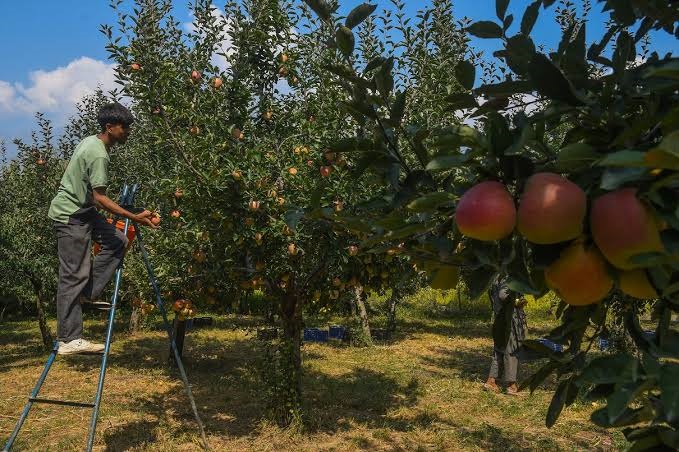
Men from Bihar and other parts of India travel north into Kashmir, following contractors, orchard owners and years-old work networks. They arrive not as tourists or visitors, but as agricultural workers—picking fruit, pruning trees, carrying crates, sorting apples and helping growers get a crop that has taken an entire year to produce into the market within a narrow harvesting window.
For some, the journey is now a familiar annual routine. For others, Kashmir has become almost a second workplace.
And yet, beneath that economic relationship lies a darker reality.
Migrant workers have repeatedly been targeted by militants in Jammu & Kashmir. The latest deadly attack came on July 31, 2026, when two workers from Chhattisgarh were shot at a brick kiln in Kulgam; both eventually died.
The victims were not apple workers, but the attack once again sent a message through the wider migrant workforce—including those working in orchards.
The paradox is striking: the same Valley where migrant labourers can face serious security risks also depends on their labour to keep parts of its rural economy functioning.
That dependence becomes particularly visible during apple harvest.
Kashmir’s Apple Economy Needs Thousands of Hands
Horticulture is not a marginal activity in Kashmir. It is one of the foundations of the rural economy.
A Jammu & Kashmir Trade Promotion Organisation document describes the apple sector as the backbone of the rural economy, estimating that the industry provides around 400 man-days of employment per hectare, supports millions of people and accounts for a substantial share of the region’s horticultural output. It also identifies Baramulla, Shopian, Kupwara, Anantnag, Kulgam, Budgam and Pulwama among the principal apple-production districts.
The work involved in getting an apple from tree to market is extensive.
There is pruning before the season, orchard maintenance, harvesting, carrying, grading, sorting, packing, loading and transportation.
During the harvest window, all of these activities become time-sensitive.
An apple left hanging too long can fall or deteriorate. Fruit harvested too early can lose quality. Once picked, it has to move through packing and transportation networks quickly.
That is where migrant labour has become particularly important.
A 2025 report from Kashmir Life noted that tens of thousands of workers from Bihar, as well as Jammu & Kashmir’s Chenab Valley, Rajouri and Poonch, were working in apple orchards during the harvest, with growers reporting harvesting wages of roughly ₹800–₹1,100 per day.
The workforce is therefore not a small supplementary labour pool.
It has become an important component of the seasonal agricultural system.
Why Workers From Bihar Keep Coming Back
For workers from rural Bihar, Kashmir offers something that is increasingly difficult to find at home: relatively well-paid seasonal work.
A recent Indian Express ground report followed migrant workers in Kashmir and found that many return year after year because the wages are substantially better than what they can earn in some forms of agricultural work back home.
One worker from Katihar, Bihar, who has spent more than two decades working in South Kashmir, told the newspaper that he now earns around ₹800–₹900 a day while working with orchards.
The economics are straightforward.
A few months of relatively steady work can provide savings that support an entire household back home.
That money can pay for food, education, medical expenses, house construction, weddings or agricultural investment.
For workers with limited opportunities in their home districts, the risk calculation can therefore be brutally practical:
staying home may mean earning too little; coming to Kashmir means earning more, but accepting a degree of uncertainty.
The decision is rarely about politics.
It is about livelihood.
The Orchard Becomes Home During Harvest
For seasonal workers, the workplace and living space can sometimes overlap.
Workers may stay in rented rooms, labour camps or temporary accommodation arranged by employers. Some agricultural workers live close to the orchards where they work.
Previous reporting has documented migrant orchard workers living in basic structures, including tin sheds and temporary shelters. In one 2022 Shopian attack, two Uttar Pradesh workers who had come specifically for apple harvesting were living in a tin shed covered with a tarpaulin when militants attacked them with a grenade.
Such arrangements make economic sense for employers and workers: staying near the orchard reduces commuting costs and allows workers to start early and work long hours.
But it can also create vulnerability.
A temporary shelter in an isolated orchard is not equivalent to a secure residential neighbourhood.
Workers may have limited access to healthcare, transportation, communications and emergency services.
And because many are unfamiliar with the surrounding area, their ability to respond to a security emergency can be limited.
The Human Cost of Kashmir’s Security Problem
The security risks facing non-local workers are not hypothetical.
In October 2021, killings of migrant labourers triggered a major exodus from Kashmir, with workers travelling to Jammu and onward to their home states.
In June 2022, terrorists killed 17-year-old Dilkhush Kumar from Bihar, who was working at a brick kiln in Budgam. Another migrant worker was injured in the same attack.
In July 2023, three workers from Bihar were shot and injured in Shopian. J&K Police later filed a chargesheet against six accused in connection with the attack.
In October 2024, Ashok Chauhan, a migrant worker from Bihar, was abducted and killed in Shopian. His bullet-riddled body was recovered near the Rambiara River.
Days later, two workers from Uttar Pradesh were shot in Budgam.
And in July 2026, two workers from Chhattisgarh were attacked at a brick kiln in Kulgam. One died at the scene and the second, initially critically injured, subsequently died in hospital.
The pattern is therefore real, although it needs to be described carefully.
There have been repeated attacks on non-local workers, but not every attack involved apple workers, and the available evidence does not establish that every incident was part of one centrally coordinated campaign.
What can be established is that militant violence has repeatedly demonstrated the vulnerability of migrant labourers.
The 2026 Kulgam Attack Was a Warning Beyond the Brick Kiln
The July 31 Kulgam attack did not take place in an apple orchard.
The two victims were working at a brick kiln in the Kelam area.
But the implications reached well beyond the brick-kiln workforce.
Kashmir’s migrant workforce moves between sectors depending on the season. Construction, brick kilns, agriculture, horticulture, road work, packing and other activities draw workers from Bihar, Uttar Pradesh, West Bengal, Punjab, Chhattisgarh and other states.
A recent Indian Express investigation described migrant labour as deeply embedded across Kashmir’s economy, from construction and brick kilns to apple orchards, saffron farms and fruit storage. The report estimated—while noting the absence of an official comprehensive figure—that hundreds of thousands of non-Kashmiris work in the Valley.
So when violence targets one group of migrant workers, the psychological impact can spread across the wider labour network.
One contractor may call another.
A worker may call home.
A family may tell a relative not to travel.
And suddenly a security incident becomes an economic problem.
When Workers Leave, Orchards Feel the Shock
Kashmir has experienced this before.
In 2019, when large numbers of non-local workers left the Valley amid heightened uncertainty, orchard owners struggled to find replacement labour during the harvest season.
In 2019, Kashmir Reader reported that apple growers in Anantnag and Kulgam were unable to find enough workers for picking and packing after migrant labourers left.
The same problem became acute after attacks on non-local workers in 2019.
The Wire reported that after a series of attacks, migrant workers and traders fled South Kashmir during the apple-picking season, leaving growers scrambling for labour. Some growers had to rely on a smaller pool of local workers at higher rates.
The lesson is straightforward:
The migrant workforce is economically replaceable in theory, but not necessarily at short notice during a time-critical harvest.
Why Kashmir’s Youth Do Not Simply Fill the Gap
It is tempting to ask a simple question:
Why do Kashmir’s apple growers not employ local workers instead?
The answer is more complicated.
Kashmir has its own labour force, and local people certainly participate in horticulture.
But the scale, timing and nature of orchard work create a different labour requirement.
Harvesting can require large numbers of workers for a concentrated period. Migrant workers are often willing to undertake physically demanding work for long hours and move from one orchard or district to another depending on demand.
Some local young people increasingly seek salaried employment, professional careers, government jobs or opportunities outside agriculture.
That does not mean Kashmiri youth “refuse” agricultural work as a blanket rule. It means the Valley’s labour market has changed.
The result is a seasonal gap that migrant workers help fill.
Wages Explain Part of the Relationship
The economics of the migrant-worker system are visible in the wages.
The Indian Express recently reported workers from Bihar earning around ₹800–₹900 a day in orchard work, while a 2025 report from Kashmir Life cited harvesting rates of ₹800–₹1,100 a day in parts of South Kashmir.
For workers from poorer rural areas, these wages can be attractive.
For orchard owners, however, rising labour costs are becoming another pressure on an already expensive crop.
Harvesting is only one component of the cost structure. Packaging, transportation, storage, pesticides, fertilisers and orchard maintenance all add to production expenses.
In 2025, growers in Shopian were already reporting severe pressure from labour costs alongside market and transport problems.
So the relationship is not simply one of employer dependence.
It is a two-way economic dependency.
Workers need Kashmir’s wages. Growers need workers’ labour.
Apple Harvesting Is Only One Part of a Much Bigger Migrant Economy
The image of a Bihar worker picking apples captures only one portion of the migrant labour economy.
Migrant workers also play major roles in:
- construction;
- brick kilns;
- road projects;
- fruit packing;
- cold storage;
- transport;
- agriculture;
- hotels and restaurants;
- and other labour-intensive services.
A February 2026 report on Kashmir’s cold-storage sector found migrant workers making up a significant part of the workforce in fruit storage and packing operations. One company reported salaries around ₹17,000–₹18,000 a month, while another manager said migrants formed nearly half of the workforce at his facility.
This means migrant labour is not simply a seasonal convenience.
It has become woven into Kashmir’s wider economic infrastructure.
From Orchard to Cold Store: The Hidden Labour Chain
Consider the journey of one apple.
It begins with an orchard worker tending a tree.
Another worker may pick the fruit.
Someone else carries the crates.
Packers sort apples according to size and quality.
Workers place fruit into trays and cartons.
Drivers transport it to a mandi or cold store.
Warehouse workers stack and preserve it.
Transporters eventually take it towards markets outside J&K.
A disruption at any point can create losses.
That is why labour shortages can have consequences far beyond individual workers.
They can affect the speed at which fruit leaves the orchard, the quality of the produce, the cost of packing and ultimately the farmer’s return.
Kashmir’s apple industry has already demonstrated how vulnerable it is to disruptions unrelated to labour. In 2025, highway closures caused major losses during the peak harvest, while Indian Railways introduced parcel services to help move apples towards Delhi.
Labour security is therefore another component of supply-chain security.
The Claim That Apple Exports Would “Collapse” Needs Qualification
It would be misleading to say that without Bihar workers, Kashmir’s apple exports would simply collapse.
The apple industry has local workers, workers from other parts of India, mechanisation and different labour arrangements.
But history shows that large-scale sudden departures of migrant labour can seriously disrupt harvesting and packing, particularly when they happen during the narrow harvest window.
That is the more defensible conclusion.
The issue is not that Kashmir literally has no labour without migrants.
It is that the Valley’s existing agricultural system has become dependent on a large, mobile workforce that can be difficult to replace quickly.
A Workforce Living With Two Kinds of Vulnerability
Migrant workers face economic vulnerability as well as security vulnerability.
Many arrive without the social networks available to permanent residents.
They may depend entirely on contractors or employers for work and accommodation.
They can have limited knowledge of local institutions.
Some may hesitate to approach authorities unless they face a serious emergency.
And when a security incident occurs, rumours can travel faster than official information.
This can produce panic.
The 2021 attacks demonstrated how quickly fear could trigger mass departures.
The economic consequences then spread to farmers, contractors, traders and transporters.
Yet Many Workers Keep Returning
Perhaps the most striking part of the story is that workers continue to come.
The reason is not difficult to understand.
For many, the alternative is not a comfortable life at home.
It is another form of economic hardship.
The Indian Express recently reported workers describing how the money earned in Kashmir supports families, education and major household expenses. One Bihar worker spoke of saving for his daughter’s wedding.
This is why security risk does not automatically end migration.
People weigh risk against necessity.
That calculation can be uncomfortable to discuss, but it is fundamental to understanding why migrant workers return even after deadly attacks.
The Human Relationship Between Grower and Worker
There is also another side to the story that can disappear amid discussions of militancy.
Many migrant workers have been coming to the same villages and orchards for years.
They know the growers.
They know the trees.
They know when a particular orchard’s crop is ready.
Some have built long-term relationships with employers.
A migrant worker who returns to the same orchard every year is no longer simply an anonymous seasonal labourer.
He becomes part of the production cycle.
That familiarity can create a degree of social protection.
But it cannot eliminate the wider security threat.
An orchard may be peaceful for months or years and still become vulnerable during a sudden militant incident.
Security Agencies Face a Difficult Balancing Act
Protecting migrant workers presents a complicated operational challenge.
They are spread across thousands of workplaces rather than concentrated in one location.
An orchard can cover large areas.
Brick kilns and construction sites may lie outside dense settlements.
Workers often move between sites.
Providing permanent security personnel at every orchard is neither practical nor necessarily desirable.
The security response therefore has to involve a combination of:
- intelligence gathering;
- registration and verification where appropriate;
- communication channels;
- local police engagement;
- employer responsibility;
- emergency response;
- targeted protection of vulnerable locations;
- and rapid action against threats.
After the July 2026 Kulgam attack, authorities reviewed security arrangements and intensified operations in the area.
But long-term protection requires more than a response after an attack.
The challenge is preventing workers from becoming easy targets in the first place.
Beyond Security: Healthcare, Housing and Dignity
The migrant-worker question is also a labour-rights question.
If workers are living for months in Kashmir, their wellbeing cannot be reduced to whether they are protected from militants.
They need:
safe accommodation, clean drinking water, sanitation, healthcare, access to emergency services and timely wages.
The recent Indian Express investigation into migrant workers in Kashmir highlighted how some workers live and work under difficult conditions, with their lives largely centred around earning and sending money home.
This is particularly important in orchards.
Agricultural workers can spend long hours outdoors, sometimes exposed to cold, rain, pesticides and physically demanding work.
Their contribution to Kashmir’s horticulture economy should therefore also be viewed through the lens of labour dignity.
A Shared Economic Interest Across Regions
There is an interesting economic bridge running between Kashmir and Bihar.
Kashmir provides the employment.
Bihar provides part of the workforce.
The worker sends money home.
The grower gets the crop harvested.
The trader gets fruit to the market.
The consumer eventually buys the apple.
The relationship is part of a much larger internal migration system within India.
It also challenges the simplistic idea that migrant workers are outsiders disconnected from Kashmir’s economy.
They may not have permanent homes in the Valley, but their labour is deeply embedded in it.
The Bigger Security Message
Militant attacks on non-local workers have historically served more than one purpose.
They kill individuals, but they can also generate fear among thousands of others.
When a worker leaves Kashmir, the impact extends to his employer.
When hundreds leave, the impact reaches an industry.
And when a whole seasonal workforce begins questioning whether it should return, the psychological impact can become much larger than the number of people directly attacked.
That is why the security of migrant workers is also an economic-security issue.
But it is important not to overstate the evidence.
The repeated attacks demonstrate vulnerability and have, at times, triggered worker departures. They do not by themselves prove that every attack was designed specifically to “collapse” Kashmir’s apple exports or that every incident formed part of a single coordinated strategy.
The stronger conclusion is simpler:
militant violence against migrant workers can disrupt labour supply, deepen fear and impose costs on an economy that depends heavily on seasonal mobility.
The Apple Tree as a Symbol of Kashmir’s Contradiction
There is something deeply revealing about the image of a migrant worker from Bihar standing beneath a Kashmir apple tree.
The tree represents prosperity.
The worker represents migration.
The orchard represents Kashmir’s rural economy.
And the security concern represents the unresolved conflict that continues to shape everyday life.
All four exist together.
The worker comes because Kashmir offers him an income he may struggle to earn at home.
The farmer hires him because harvesting a commercial orchard requires labour at scale.
The worker knows that violence has happened before.
The farmer knows that losing labour during harvest can cost him his crop.
And yet, when autumn arrives, the workers come again.
That is not simply resilience.
It is economic necessity.
What Happens If Fear Becomes Stronger Than the Wage?
That may be the most important question for Kashmir’s horticulture sector.
As long as workers believe the economic reward justifies the risk, they will continue to come.
But if repeated attacks, threats or restrictions make Kashmir feel consistently unsafe, the economic calculation could change.
The consequences would be felt first in labour-intensive sectors.
Apple growers could face shortages.
Harvesting costs could rise.
Fruit could remain unpicked.
Packing operations could slow.
Transport schedules could be affected.
And farmers already facing market, weather and highway problems could face another burden.
This is why protecting migrant workers is not only a humanitarian responsibility.
It is also sound economic policy.
Kashmir’s Horticulture Needs Both Workers and Security
The apple economy cannot be separated from the people who physically bring the fruit from tree to market.
Government statistics and industry documents show the scale of horticulture’s importance to Jammu & Kashmir.
Ground reporting shows another side: migrant workers from Bihar and other states have become an important part of the labour system supporting that economy.
And the history of targeted attacks shows how quickly that workforce can become vulnerable.
The challenge now is to ensure that these workers are not treated as invisible labour.
Their safety must be part of Kashmir’s economic planning.
Their accommodation and healthcare need attention.
Employers need clear responsibilities.
Security agencies need reliable communication and intelligence mechanisms.
And workers themselves need a way to report threats without fear or bureaucratic obstacles.
Because the men working among Kashmir’s apple trees are doing more than picking fruit.
They are participating in one of the Valley’s most important economic activities.
They come from Bihar, Uttar Pradesh, Chhattisgarh and elsewhere, but for a few months each year, their labour becomes part of Kashmir’s agricultural rhythm.
The tragedy is that they sometimes have to make that journey while knowing that others like them have been attacked before.
The apple harvest needs their hands. Kashmir’s economy needs their labour. And they deserve the security to return home safely after the season ends.


