Rahul Gandhi, Priyanka Gandhi Among Hundreds Detained During Anti-CEC Protest in Delhi
By: Javid Amin | 06 October 2026
INDIA bloc protest over CEC Gyanesh Kumar, SIR and electoral-roll concerns ends with prolonged sit-in, police action and late-night release of opposition leaders
New Delhi witnessed a prolonged political confrontation on October 6 as Congress leaders Rahul Gandhi and Priyanka Gandhi Vadra, along with several other INDIA bloc leaders and MPs, were detained by Delhi Police following hours of protest against Chief Election Commissioner Gyanesh Kumar and the Election Commission of India.
The confrontation began with an INDIA bloc march from Parliament towards the Election Commission headquarters, but turned into a lengthy sit-in at Akashvani Bhawan after police barricades stopped the protesters from proceeding towards Nirvachan Sadan.
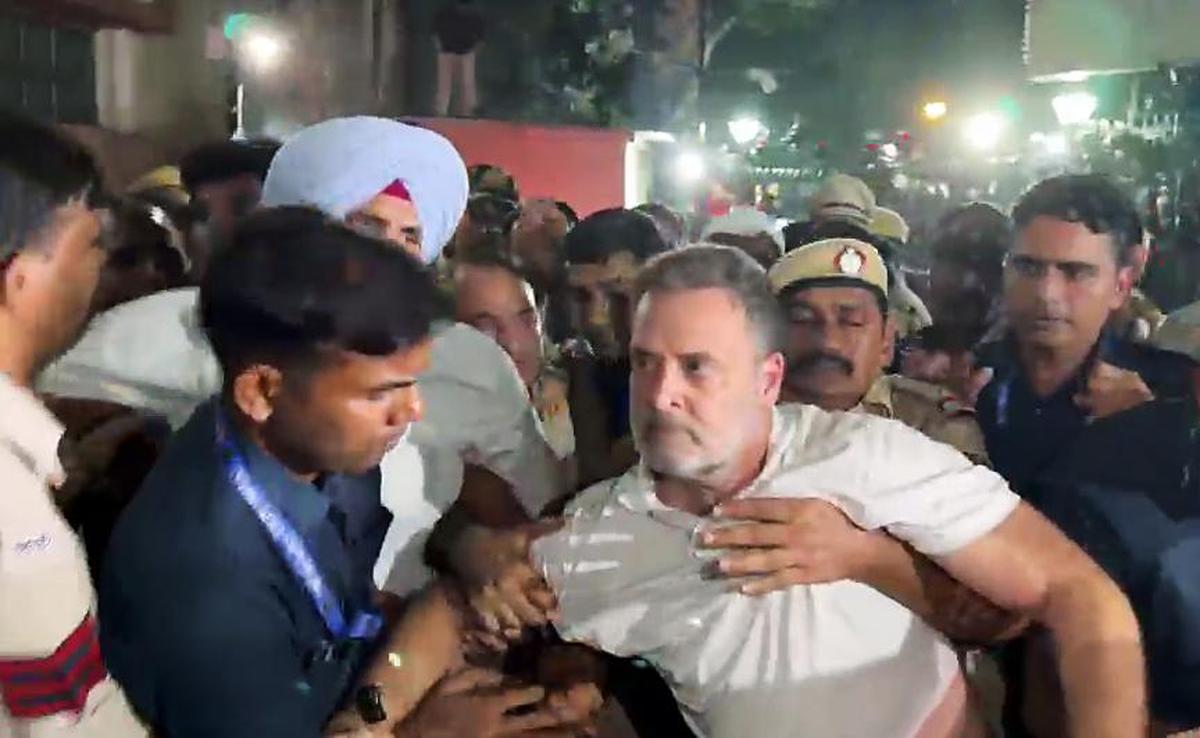
Police later cleared the premises and detained the protesters. Reports put the total number of people detained at around 250 to 260, although the exact figure varied across police and media accounts. Around 50 MPs were cited among those detained in some reports. The detained leaders were taken to police facilities, including the New Police Lines at Kingsway Camp, before being released later in the night.
The episode has added another layer to an increasingly contentious dispute between opposition parties and the Election Commission over the Special Intensive Revision (SIR) of electoral rolls, alleged irregularities in the revision process and questions surrounding the functioning of the three-member poll panel.
From Parliament to Akashvani Bhawan: How the Protest Unfolded
The INDIA bloc’s demonstration was planned as a march from Parliament towards the Election Commission headquarters.
The protesters wanted to meet the Election Commissioners and press their demands concerning the SIR exercise and the functioning of the Commission under Gyanesh Kumar. Police stopped the march near the area around NITI Aayog and other barricaded points close to the Commission’s office.
According to Delhi Police, no formal application seeking permission for the march had been submitted to the Deputy Commissioner of Police, New Delhi district. Police said restrictions had also been imposed in the New Delhi area and that repeated announcements were made asking protesters to disperse.
The protesters, however, continued their demonstration.
Rahul Gandhi was seen climbing a police barricade while carrying the national flag as opposition MPs raised slogans against the Election Commission and demanded Kumar’s resignation.
As the police action intensified, several leaders were detained.
But the protest did not end there.
Rahul Gandhi, Priyanka Gandhi Vadra and a group of other Congress leaders managed to reach the Akashvani Bhawan premises, where they began a sit-in. The demonstration continued for more than eight hours, turning the area into the centre of a prolonged standoff between the opposition and the police.
Why Rahul Gandhi and the Opposition Are Targeting the CEC
At the heart of the confrontation is the Election Commission’s Special Intensive Revision of electoral rolls.
Opposition parties have alleged that the revision process could result in legitimate voters being excluded and have raised questions about the manner in which decisions connected with the exercise were taken.
Rahul Gandhi and other INDIA bloc leaders have repeatedly used the phrase “vote chori”, alleging that irregularities in electoral rolls could affect the integrity of elections.
Their demand has gone beyond changes to the voter-list process. The opposition has called for the resignation of Chief Election Commissioner Gyanesh Kumar and has sought direct engagement with the Election Commission over the allegations.
These remain political allegations by the opposition and have not been established as findings against the CEC.
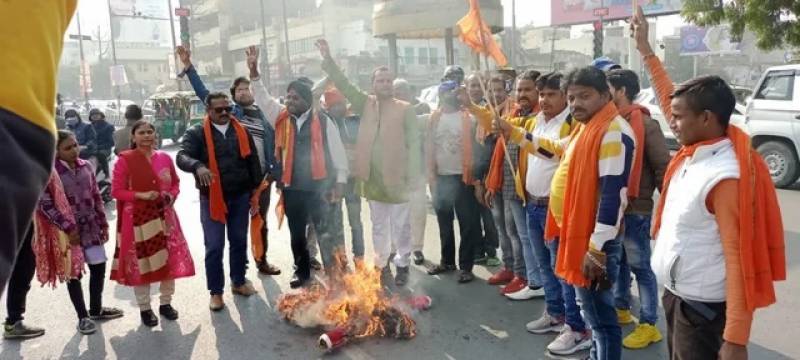
The Election Commission has disputed the opposition’s characterisation of the process, while the BJP has rejected the allegations and criticised the protests.
A Key Question: Did the Opposition Seek a Meeting With the ECI?
One of the immediate points of dispute concerns whether the protesters had formally sought an appointment with the Election Commission.
The opposition said it wanted to meet the Election Commissioners and submit its concerns.
The Election Commission, however, said on Tuesday that it had not received a formal request from any political party for a meeting at its headquarters at that stage. Later, according to an account reported by The Indian Express, the Commission said police informed it that MPs wanted a meeting at Parliament House Annexe, which it described as unusual because meetings with political parties are ordinarily held at the Commission’s premises.
That disagreement became part of the larger confrontation.
For the opposition, the inability to directly engage with the poll panel became another reason to continue the sit-in. For the Commission, the question of protocol and the absence of a formal appointment became central to its response.
Police Clear Akashvani Bhawan After Hours-Long Sit-In
The standoff eventually moved into the evening.
Police entered the Akashvani Bhawan premises to remove the protesters after they refused to leave.
Among those detained were Rahul Gandhi, Priyanka Gandhi Vadra, K C Venugopal, Pawan Khera and other senior opposition leaders. Some reports said around 50 MPs were among those initially detained, while Delhi Police sources separately gave a broader figure of around 260 people detained during the day’s events.
The police said the action was necessary after protesters allegedly breached barricades, continued despite warnings and entered the Akashvani premises without permission.
The opposition, meanwhile, described the police action as an attempt to prevent it from raising questions about the electoral process.
The detainees were taken away in police vehicles and subsequently released later that night.
The Larger Battle Over SIR
The Delhi confrontation cannot be separated from the rapidly expanding controversy surrounding SIR.
The dispute intensified further after the Supreme Court on October 5 refused to grant an interim order suspending Chief Election Commissioner Gyanesh Kumar, while issuing notices to the Election Commission, the Centre and other respondents.
The petitions before the Court concern allegations that a number of SIR-related decisions were taken in the name of the Election Commission despite objections recorded by Election Commissioners Sukhbir Singh Sandhu and Vivek Joshi.
The Court has not accepted those allegations as established facts. Instead, it has sought responses and relevant records before deciding the legal questions.
The Court also questioned the issue surrounding a modified Form 6, with Chief Justice Surya Kant making clear that the Supreme Court had not approved any modified version of the form.
That judicial scrutiny has given the opposition’s political campaign an additional institutional backdrop, even though the Court’s proceedings and the opposition’s political allegations remain separate matters.
BJP Rejects Opposition’s Charges
The BJP has strongly rejected the opposition’s allegations against the Election Commission.
BJP leaders have accused Congress and its allies of using the electoral-roll controversy to attack an independent constitutional institution and of turning electoral setbacks into allegations against the poll body.
Union ministers and BJP spokespersons also criticised the protest itself, arguing that Congress should address its electoral performance politically rather than blame the Election Commission.
BJP spokesperson Sudhanshu Trivedi separately criticised Rahul Gandhi over his entry into the Akashvani Bhawan premises and rejected Congress’s allegations concerning SIR.
The BJP’s position is therefore substantially different from that of the INDIA bloc: while the opposition is demanding accountability from the CEC and questioning the electoral-roll process, the BJP has defended the Commission and characterised the opposition’s campaign as politically motivated.
Rahul Gandhi Escalates His Political Attack
During the sit-in, Rahul Gandhi intensified his criticism of the government, the BJP and the Election Commission.
He demanded that the CEC meet opposition representatives and repeatedly linked the SIR controversy with broader questions about electoral integrity.
The protest also produced a series of highly political statements from Gandhi directed at the BJP leadership and the Election Commission. Those remarks are part of the political contest surrounding the issue and should be distinguished from any legal finding by a court or institutional determination by the Election Commission.
Priyanka Gandhi Vadra remained alongside him during the sit-in before both were eventually detained.
A Protest That Became an Institutional Confrontation
What began as an opposition march has now become part of a much wider confrontation involving three institutions and political forces: the opposition parties, the Election Commission and the judiciary.
The opposition is demanding answers about voter-list revisions and the functioning of the Commission.
The Election Commission maintains that its procedures are governed by law and has challenged the opposition’s account of events.
The Supreme Court, meanwhile, has begun examining specific allegations and has asked the relevant authorities to respond.
That distinction is important.
A political allegation is not the same as a judicial finding. A Supreme Court notice is not a finding of wrongdoing. And the detention of political leaders does not by itself establish whether the underlying electoral allegations are correct.
Those questions remain subject to institutional scrutiny.
Why the October 6 Protest Matters
The immediate political significance of the Delhi protest lies in the fact that the dispute over electoral rolls has moved beyond parliamentary statements and press conferences into sustained street mobilisation.
The INDIA bloc has now demonstrated its willingness to keep the issue in public view through coordinated protests, while the government and BJP have shown no indication of accepting the opposition’s demand for the CEC’s resignation.
The Supreme Court’s intervention has further raised the institutional stakes by requiring the ECI and other respondents to explain the decisions under challenge.
For the Election Commission, the issue is therefore no longer confined to a political dispute. Its procedures and decision-making are also facing judicial scrutiny.
For the opposition, the central challenge will be to substantiate its allegations through documentary and electoral evidence rather than political rhetoric alone.
What Happens Next?
The October 6 detention ended with the release of Rahul Gandhi, Priyanka Gandhi and the other detained leaders, but it did not resolve the underlying dispute.
The Supreme Court proceedings over the alleged unilateral SIR decisions will continue, with the ECI and other respondents expected to place their responses and records before the Court.
At the political level, the opposition has indicated that it intends to continue pressing the issue.
The controversy is therefore likely to remain centred on three questions:
Were the disputed SIR decisions taken in accordance with the Election Commission’s statutory decision-making framework?
What do the official records show about the objections reportedly raised within the Commission?
And can the competing political claims about electoral-roll irregularities ultimately be established through verifiable evidence?
Until those questions are answered through the appropriate institutional processes, the Delhi confrontation remains an intense political dispute rather than a settled finding about the integrity of the electoral process.
For now, however, the images of Rahul Gandhi and Priyanka Gandhi being detained after hours of protest have ensured that the fight over the Election Commission and SIR has moved firmly to the centre of India’s political conversation.