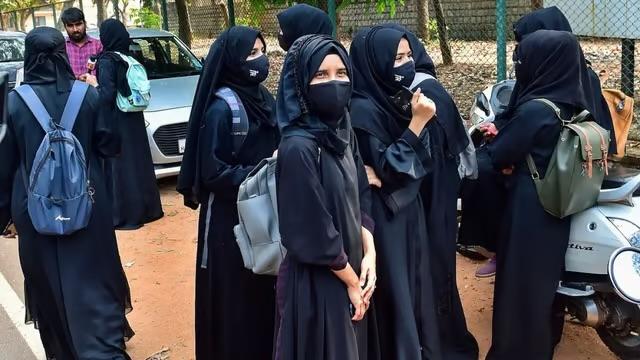
Chembur Trombay Education Society’s NG Acharya and DK Marathe College has imposed ban on wearing hijab, niqab, and burqa
The Supreme Court on Friday stayed a circular issued by a Mumbai college that imposed a ban on wearing hijab, niqab, burqa, caps, and similar attire within its premises. The court, however, said no burqa can be allowed to be worn by girls inside the classroom and no religious activities can be permitted on the campus.
A bench of Justices Sanjiv Khanna and Sanjay Kumar questioned the college’s selective ban on religious symbols, asking why it had not extended the prohibition to other markers of religion, such as tilak and bindi, if the intention was to enforce a uniform dress code.
“Girl students must have freedom of choice in what they are wearing and college cannot force them…It’s unfortunate that you suddenly wake up to know that there are many religions in the country,” the bench told the college administration at the centre of a fresh row over a dress code for Muslim students.
“Can you say someone wearing a tilak will not be allowed? This is not part of your instructions?” Justice Kumar asked, as per Live Law.
The apex court was hearing a plea challenging a Bombay high court verdict from June, which refused to interfere with the college’s decision to implement the ban.
Nine female students enrolled in the second and third years of a science degree course had challenged the college’s directive on the grounds that it violated their fundamental rights, including the right to practice their religion, right to privacy, and right to choice.
How the controversy started
The controversy began on May 1, when the Chembur Trombay Education Society’s NG Acharya & DK Marathe College issued a notice on its official WhatsApp group, which included faculty members and students. The notice outlined a dress code that banned the wearing of hijab, niqab, burqa, caps, badges, and stoles on the college premises. The petitioners, in their plea, argued that this directive was issued without any legal authority and was therefore “bad-in-law, null and void.”
The students initially approached the college management and the principal, requesting the withdrawal of the restrictions on hijab, niqab, and burqa, citing their right to choice, dignity, and privacy in the classroom. When their requests were ignored, they escalated the matter to the chancellor and vice-chancellor of Mumbai University, as well as the University Grants Commission, seeking intervention to ensure that education was imparted without discrimination. However, after receiving no response, the students filed a petition in the Bombay high court.
During the hearing in the high court, the petitioners’ advocate, Altaf Khan, presented verses from the Quran to argue that wearing a hijab was an essential part of Islam. The plea said that the college’s action was “arbitrary, unreasonable, bad-in-law, and perverse.”
The college management defended the ban as a measure to enforce a uniform dress code and maintain discipline, denying any intent to discriminate against the Muslim community. Senior counsel Anil Anturkar, representing the college, said the dress code applied to students of all religions and castes.